Macros to Build Muscle: Setting Gain Targets and Surplus
Macros for muscle gain start with a calorie surplus. Protein sits at 1.6 to 2.2 g per kg. Fat takes about a quarter of calories, and carbohydrate fills the rest. A surplus of about 10% suits most lifters. For an 82 kg man that is roughly 3,086 calories a day.
This page shows how to size the surplus and split it into grams. It also covers adjustments after a few weeks. It includes four worked profiles, a surplus comparison and common mistakes. To run your own numbers, set the goal to muscle gain in the free macro calculator.

Macros for Muscle Gain: What Changes in a Surplus
Building muscle takes a calorie surplus and a training stimulus. The surplus supplies the energy to build new tissue, and protein supplies the raw material. Macros for muscle gain use the same three nutrients as any plan, set at different levels. Calories rise, protein stays high and carbohydrate takes most of the extra energy.
Compared with fat loss, protein can drop slightly, because a surplus protects muscle on its own. The calculator’s default moves from 2.0 g per kg in a deficit to 1.8 g per kg in a surplus. Fat stays near 25% of calories, and carbohydrate fills what remains. That is why gaining diets look carb-heavy.
What Macros Are and Why Calories per Gram Matter
Macros are the three nutrients that supply calories: protein, carbohydrate and fat. Plans sold as muscle gain macros or macros for weight gain are just these three numbers set above maintenance. Protein and carbohydrate each give 4 calories per gram, and fat gives 9. The basics are covered in what are macros.
Those numbers let you check any plan. For the man in Example A below, 148 g protein, 431 g carbohydrate and 86 g fat add up to 3,090 calories, which matches his 3,086 target within rounding. Fat is the densest source, so a small shift in fat moves calories more than the same shift in carbohydrate.
How to Calculate Calories for Muscle Gain
Start with your maintenance level, then add the surplus. Estimate resting energy with the Mifflin-St Jeor equation, multiply by an activity factor, and add your chosen percentage or preset. The steps are explained in BMR and TDEE and compared in BMR equations.
That list is the whole method for how to calculate macros for muscle gain: calories first, then protein, fat and carbohydrate. If you know your body fat, the calculator uses Katch-McArdle instead, and Example D shows the difference. If you already know your maintenance calories from tracking, enter them directly.
How Big a Surplus: Rate of Gain and Presets
A bigger surplus does not build muscle faster once you pass a modest level, and the excess goes to fat. Reviews of off-season bodybuilding nutrition, such as Iraki and colleagues in 2019, suggest gaining roughly 0.25 to 0.5% of body weight a week for most lifters. Beginners can sit nearer the top of that range, and experienced lifters nearer the bottom, because their potential for new muscle is smaller.
The calculator gives two ways to set the surplus. The default adds 10% to your maintenance calories, and the weekly presets add a fixed amount of energy. A preset of 0.5 lb a week adds about 250 calories a day, and 1 lb a week adds about 500. Treat these as approximations, not forecasts.
Option | Daily surplus | Calories (82 kg man) | Rate as share of body weight |
|---|---|---|---|
Maintenance | 0 | 2,806 | Stable |
Preset +0.5 lb a week | About 250 | 3,056 | About 0.28% a week |
Default +10% | About 280 | 3,086 | About 0.3% a week |
Preset +1 lb a week | About 500 | 3,306 | About 0.55% a week |
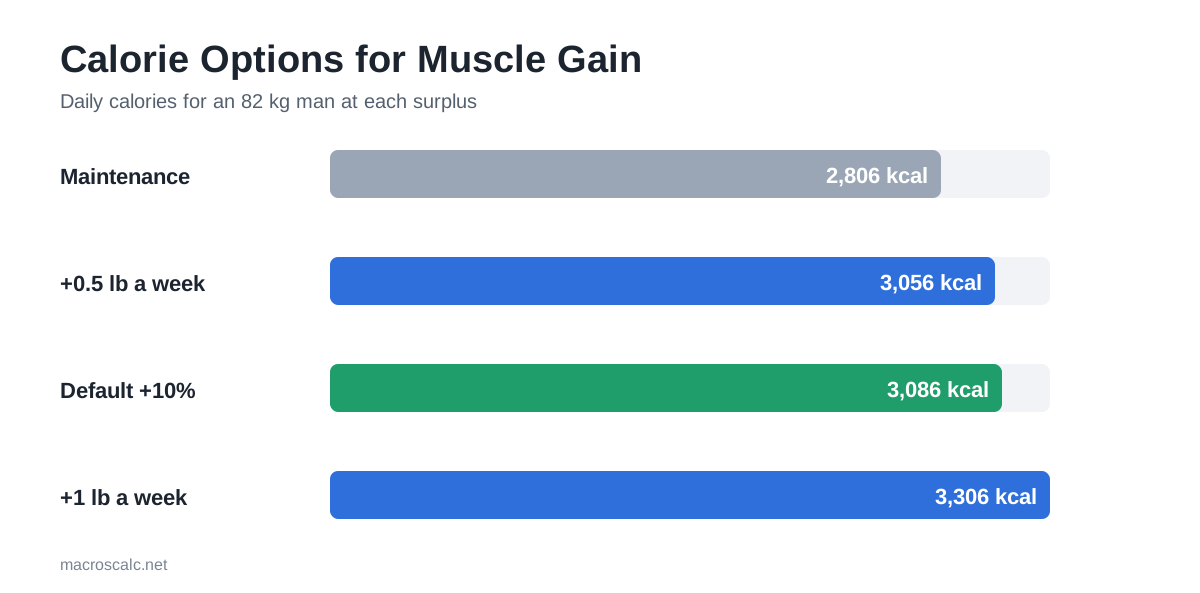
The 1 lb option sits above the 0.5% a week guideline for this lifter. It suits a beginner or a hard gainer rather than most people. If you are unsure, start with the default or the 0.5 lb preset and adjust from your own weight trend.
Lean Gaining vs Dirty Bulking
A lean approach keeps the surplus modest, so most of the weight gained is muscle. A dirty approach eats as much as possible and accepts extra fat. The difference is mainly the size of the surplus, and a smaller one costs little muscle while adding less fat.
Gaining Muscle at Maintenance
Beginners and people returning to training can build muscle with no surplus, a pattern called body recomposition. The calculator’s recomposition goal keeps calories at maintenance and raises protein to 2.0 g per kg. For the 82 kg man that is 2,806 calories with 164 g protein, 362 g carbohydrate and 78 g fat.
Surplus by Training Experience
How fast you can gain muscle depends on how long you have trained. Beginners respond quickly, so they can use a larger surplus and still gain mostly muscle. Experienced lifters add muscle slowly, and a large surplus mostly adds fat.
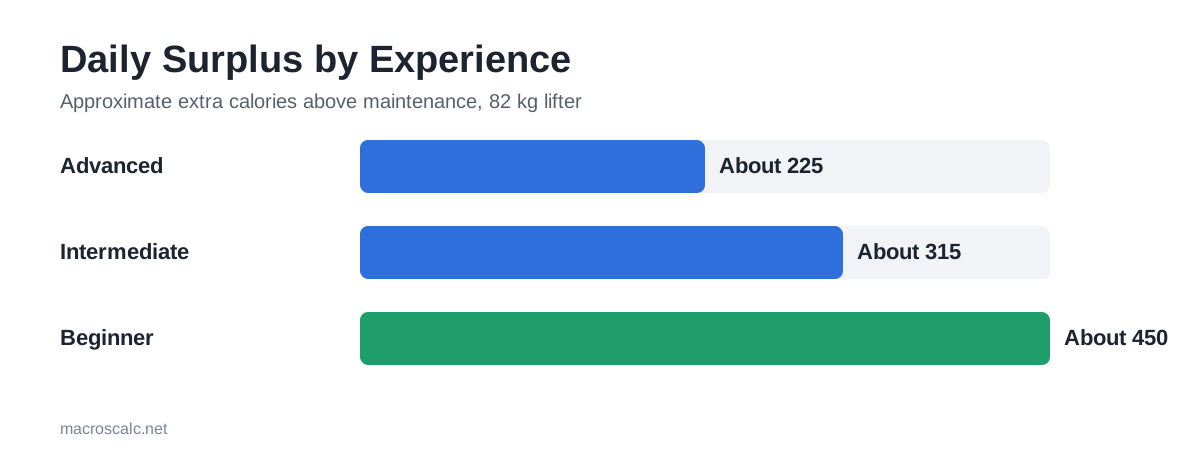
The table turns that into rates and daily surpluses for the 82 kg man in Example A. The figures are planning estimates, not forecasts, and they assume about 7,700 calories per kg of weight gained. Treat them as a range to start inside, then adjust from your own trend.
Experience | Rate (share of body weight a week) | Weight per week (82 kg) | Approx. daily surplus | Resulting calories |
|---|---|---|---|---|
Advanced, 3+ years of steady training | About 0.25% | 0.2 kg (0.45 lb) | About 225 | About 3,030 |
Intermediate, 1 to 3 years | About 0.35% | 0.29 kg (0.63 lb) | About 315 | About 3,120 |
Beginner, under 1 year | About 0.5% | 0.41 kg (0.9 lb) | About 450 | About 3,255 |
Pick the row that matches your history. The default 10% surplus sits between the intermediate and beginner rows. Women can use the same percentages of body weight, and the macros for muscle gain then follow from the calorie target, with protein and fat set first.
The chart shows how the daily surplus rises as training experience falls.
Protein, Fat and Carbohydrate in a Surplus
Protein comes first, set per kilogram of body weight. The default is 1.8 g per kg, inside the 1.6 to 2.2 g per kg range supported by the 2018 Morton meta-analysis and the 2017 ISSN position stand. For the reasoning and gram tables, see how much protein per day.
Fat is set next, at about 25% of calories, with a floor of 0.6 g per kg. Fat supports hormones and absorbs fat-soluble vitamins, and going much lower rarely helps a gaining phase. For gram ranges by calorie level, see how many grams of fat per day. Carbohydrate takes the remainder, and for an 82 kg man that is about 431 g, or 5.3 g per kg.
Carbohydrate matters in a surplus because it fuels training, and hard sessions are where gains are made. If appetite is the limit, shift a little energy from carbohydrate to fat. Fat packs more calories into a smaller volume. For gram ranges by calorie level, see how many carbs per day.
Percent Splits
Percent splits are a common way to describe macros for muscle gain, but grams per kg are the better target. The percentages below come from the worked profiles. They sit inside the Institute of Medicine ranges of 10 to 35% protein, 45 to 65% carbohydrate and 20 to 35% fat. Other splits and how they convert to grams are in macro ratios.
Profile | Protein | Carbohydrate | Fat |
|---|---|---|---|
Man, default +10% (Example A) | 19% | 56% | 25% |
Man, +0.5 lb preset (Example B) | 19% | 56% | 25% |
Woman, default +10% (Example C) | 21% | 54% | 25% |
Man at maintenance, recomposition | 23% | 52% | 25% |
Spreading Protein Across Meals
The ISSN suggests about 0.4 g of protein per kg per meal across at least four meals. For the 82 kg man that is about 33 g per meal, so his 148 g fits into four meals of 37 g. There is no need for exact timing, but a protein food at each meal makes the daily total easier to reach.
Macros for Muscle Gain: Four Worked Profiles
These examples use the calculator’s defaults and an activity factor of 1.55. Maintenance calories come from the Mifflin-St Jeor equation. Each one shows the target in calories and grams.
Example A: 82 kg Man, Default Surplus
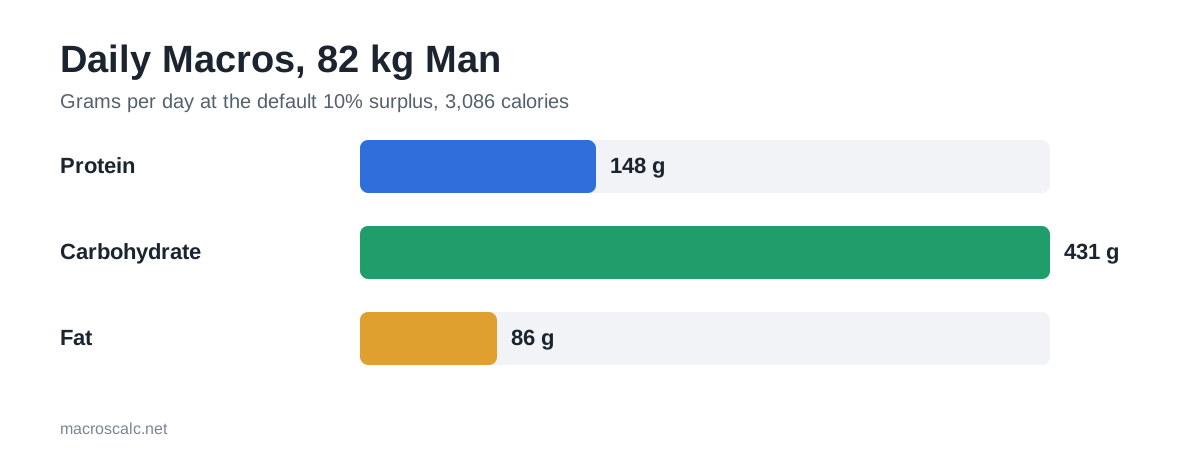
A 28-year-old man at 180 cm and 82 kg has a BMR of 1,810 and a maintenance level of 2,806 calories. The default surplus of 10% sets his target at 3,086 calories. Protein is 148 g at 1.8 g per kg, fat is 86 g and carbohydrate is 431 g. That is 19% protein, 56% carbohydrate and 25% fat.
Example B: The Same Man With Presets
With the 0.5 lb preset his target is 3,056 calories with 148 g protein, 425 g carbohydrate and 85 g fat. With the 1 lb preset it is 3,306 calories with 148 g protein, 472 g carbohydrate and 92 g fat. Protein does not change, and carbohydrate absorbs the whole increase.
Example C: 70 kg Woman, Default Surplus
A 35-year-old woman at 165 cm and 70 kg has a maintenance level of 2,163 calories. The default surplus gives 2,379 calories with 126 g protein, 320 g carbohydrate and 66 g fat. The 0.5 lb preset gives 2,413 calories with 126 g protein, 326 g carbohydrate and 67 g fat.
Example D: When Body Fat Is Known
If the man in Example A enters a body fat of 15%, the calculator switches to Katch-McArdle. His BMR becomes 1,876 and his maintenance level 2,907. The target rises to 3,198 calories with 148 g protein, 452 g carbohydrate and 89 g fat. That is 112 calories above the Mifflin-St Jeor result.
Profile | Calories | Protein | Carbohydrate | Fat |
|---|---|---|---|---|
A: man, 82 kg, default +10% | 3,086 | 148 g | 431 g | 86 g |
B1: same man, +0.5 lb preset | 3,056 | 148 g | 425 g | 85 g |
B2: same man, +1 lb preset | 3,306 | 148 g | 472 g | 92 g |
C: woman, 70 kg, default +10% | 2,379 | 126 g | 320 g | 66 g |
D: man, 15% body fat | 3,198 | 148 g | 452 g | 89 g |
The chart shows the Example A split in grams, with carbohydrate taking most of the surplus.
Macros for Muscle Gain for Women, Older Lifters and Vegetarians
Macros for gaining muscle follow the same method for everyone, and only the inputs change. Women usually get lower calorie targets for macros for muscle gain because maintenance is lower, as Example C shows. Protein in macros for muscle gain stays in the same g per kg range for all lifters.
Older lifters can benefit from the upper end of the protein range, since muscle is harder to build with age. Vegetarians and vegans can use the same targets, but they should mix legumes, soy, grains and nuts to cover amino acids. Anyone with a medical condition should follow the safety notes below.
Tracking Your Macros in a Gaining Phase
Tracking your macros for muscle gain helps most in the first two to three weeks, when you are checking whether the target matches reality. Weigh foods when you can, log them in an app, and compare your average intake with the plan. How to count macros covers a simple routine. If you prefer flexible food choices, IIFYM explains how to fit foods to your targets.
You do not need to track forever. Once you know what the target looks like in food, many lifters track loosely and check the weekly weight trend. If you cycle carbohydrate across training days, see carb cycling.
Interpreting Your Results and Adjusting After Two to Three Weeks
Treat your first macros for muscle gain as a hypothesis. Weigh yourself under the same conditions several mornings a week and compare the weekly average across two to three weeks. If you gain less than 0.25% of body weight a week and training is progressing, add 100 to 150 calories, mostly as carbohydrate.
If you gain faster than about 0.5% a week, or your waist is growing more quickly than your strength, cut 100 to 150 calories. Strength progress, not the scale alone, is the check that extra weight is useful. Early jumps in the first week are often water and glycogen, so judge the trend after that.
Common Mistakes When Gaining Muscle
Most gaining mistakes come from treating a surplus as permission to eat without limit. A measured surplus plus consistent training gives more muscle for less fat. The table lists the errors that waste a gaining phase.
Mistake | Why it hurts | Fix |
|---|---|---|
Eating as much as possible | Extra surplus turns into fat | Keep to 0.25 to 0.5% of body weight a week |
Cutting protein to make room | Reduces the raw material for muscle | Hold 1.6 to 2.2 g per kg |
Ignoring the numbers after week one | Maintenance estimates are off by 100 or more calories | Adjust from a two to three week trend |
Judging by one weigh-in | Water shifts hide the trend | Use weekly averages |
Under-training | A surplus without progressive training adds fat | Track lifts and add load |
Too little fat | Harder to hit calories and feel well | Keep fat near 25% of calories |
If your waist grows faster than your lifts, cut the surplus before you cut protein. Most of the fix is a calorie change, not a macro change.
Safety Notes for Gaining Weight
This guide is for healthy adults. Talk to a clinician or registered dietitian before setting a calorie surplus if you have a history of disordered eating. The same applies if you have a medical condition affecting digestion, blood sugar or kidney function, or take medication that affects appetite.
Teenagers, pregnant people and anyone gaining weight for a medical reason need individual guidance, because the numbers here are population averages. The calculator gives estimates, not a prescription.
FAQs
Conclusion
Macros for muscle gain come down to a modest surplus, high protein and carbohydrate for the rest. Start at about 10% above maintenance, set protein at 1.6 to 2.2 g per kg and adjust from your two to three week trend.
Use the macro calculator to see the full split for your weight and goal. If you are cutting after a gaining phase, the guide to macros for weight loss covers the deficit side, and how to calculate macros covers the method. After a cut, reverse dieting covers a gradual return to maintenance.
Sources
The surplus and protein guidance on this page comes from the papers below. Check the originals if you plan to rely on a specific figure.
Iraki’s review is a narrative review, so its ranges are guidance and not trial results.