How Many Grams of Protein per Day? Daily Needs by Goal
How much protein do I need? For most healthy adults the floor is 0.8 g per kg of body weight. Active people and dieters do better at 1.4 to 2.0 g per kg. For a 70 kg adult that is 56 g at the minimum and 112 to 140 g at higher targets.
This page turns those ranges into grams per day for your own weight and goal. It includes worked examples, a weight-by-goal table, protein per meal and food sources. To apply it, set your goal in the free macro calculator and adjust protein per kg.
How Much Protein Do I Need? The Short Answer in g/kg
Protein targets are set per kilogram of body weight, not as a flat number, so how much protein do I need depends on your size. A 55 kg person and a 95 kg person do not need the same amount. The reference minimum is the RDA of 0.8 g per kg per day, set by the National Academies in 2005. It prevents deficiency in most healthy adults, but it is not the best amount for every goal.
Beyond that minimum, the answer depends on training, calorie intake and age. Position statements and meta-analyses put resistance-trained and dieting adults at 1.4 to 2.0 g per kg. Benefits for muscle gain flatten out near 1.6 g per kg. Older adults sit between the two, at about 1.0 to 1.2 g per kg.
Use the lower end of a range when you dislike high-protein food or eat few calories from other sources. Use the upper end when you train hard, are in a deficit or are cutting for a lean look. The next sections explain why the ranges differ and how to pick a point inside them.
What Protein Does and Why Daily Intake Matters
Protein is built from amino acids, and your body uses them to repair tissue, make enzymes and hormones, and maintain muscle. Nine of these amino acids are essential, which means you must get them from food. Protein also supplies 4 calories per gram, and it is the most filling macronutrient per calorie.
A complete protein contains all nine essential amino acids in useful amounts. Meat, fish, eggs, dairy and soy are complete, while most grains, nuts and legumes are low in one amino acid. Eating a mix of plant foods across the day covers the gap. The branched-chain amino acids, leucine, isoleucine and valine, are part of this set. Supplements of them add little when your total protein is already adequate.
Your body also spends more energy digesting protein than other nutrients. About 20 to 30% of protein calories go to digestion, against 5 to 10% for carbohydrate. This small effect, plus fullness, is one reason higher intakes help during weight loss.
The Minimum vs What Active People and Dieters Need
The RDA is built to cover almost everyone’s basic nitrogen balance. It was never designed as an optimum for building muscle or protecting it during weight loss. That is why most sports nutrition guidance sits well above it.
Two sources anchor the higher ranges. The International Society of Sports Nutrition stated in 2017 that 1.4 to 2.0 g per kg per day is enough for most exercising people. A 2018 meta-analysis of 49 trials by Morton and colleagues found that extra protein improved resistance-training gains up to about 1.6 g per kg. Its confidence interval reached 2.2 g per kg.
Source | Range | Who it applies to |
|---|---|---|
National Academies RDA (2005) | 0.8 g/kg | Healthy adults, minimum to avoid deficiency |
PROT-AGE group (Bauer 2013) | 1.0 to 1.2 g/kg | Healthy adults over 65 |
ISSN position stand (Jäger 2017) | 1.4 to 2.0 g/kg | Exercising adults |
Morton meta-analysis (2018) | About 1.6 g/kg plateau, up to 2.2 g/kg | Adults doing resistance training |
The table compares the minimum against the optimal ranges, and the gap is large. At 70 kg the RDA gives 56 g, while the ISSN range gives 98 to 140 g. If you only want to avoid deficiency, the RDA is enough. If you lift or diet, the higher range is better supported.
A fair summary is that going above 1.6 g per kg has small returns for most people. Going above 2.2 g per kg has almost none for muscle gain. Extra protein beyond that mostly adds calories and cost.
The Dietary Guidelines for Americans 2025 to 2030 recommend 1.2 to 1.6 g of protein per kg of body weight a day. The older Institute of Medicine range is 10 to 35% of calories, which on 2,000 calories is 50 to 175 g. That band is wide, and the g/kg method narrows it to your own weight and goal.
How Much Protein Do I Need by Goal?
Your goal changes the target in a predictable way. In a deficit, protein is raised to help preserve lean mass and fullness. In a surplus, it is kept moderate and carbohydrate supplies most of the extra energy. The calculator uses the defaults below, which sit inside the published ranges.
The table shows each default with the range worth considering. For the full calorie method behind weight loss, see macros for weight loss. For a gaining phase, read macros for muscle gain.
Goal | How much protein (default) | Range to consider | Why |
|---|---|---|---|
Fat loss | 2.0 g/kg | 1.6 to 2.2 g/kg | Protects lean mass in a deficit and keeps meals filling |
Maintenance | 1.6 g/kg | 1.2 to 2.0 g/kg | Covers training and recovery without crowding out other foods |
Muscle gain | 1.8 g/kg | 1.6 to 2.2 g/kg | At the plateau for gains, with room for error |
Body recomposition | 2.0 g/kg | 1.8 to 2.2 g/kg | Needs a high intake because calories sit near maintenance |
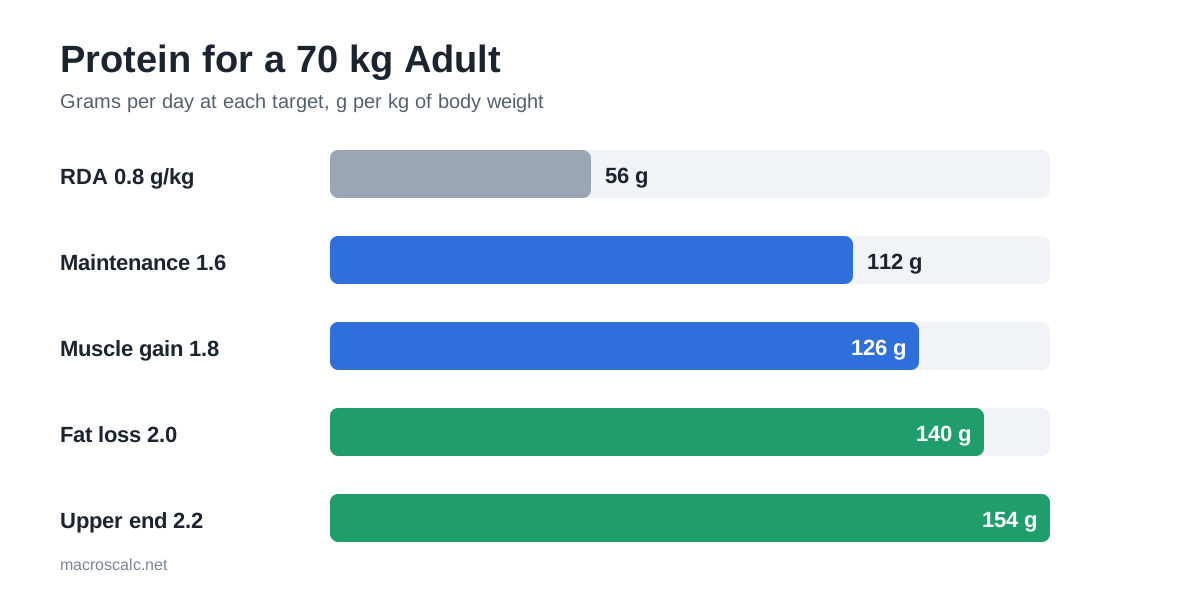
The chart answers how much protein do I need at each default for a 70 kg adult. The spread from 56 g to 154 g is almost threefold. That is why the goal matters more than any single published number.
Turning g/kg Into Grams of Protein per Day
The question how much protein do I need comes down to one multiplication, and the only trap is units. Multiply your body weight in kilograms by a g/kg value from the ranges above. If you use pounds, divide by 2.2 first. Or use the per-pound equivalents of 0.36 g/lb for the RDA and 0.73 g/lb for 1.6 g/kg.
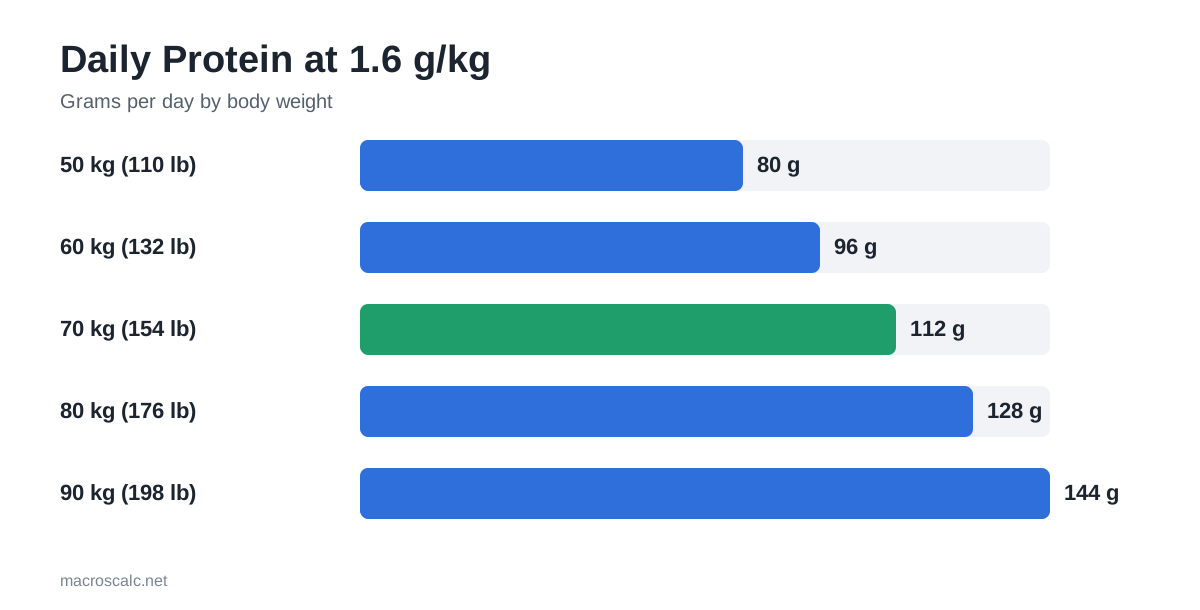
If you only want to know how many grams of protein per day fit your weight and goal, use the lookup table below. It skips the arithmetic. Each cell is grams of protein per day, rounded to whole grams. If you are heavier with a high body fat percentage, calculating from total weight can overshoot. Many coaches then use a goal weight or an estimated lean mass, and the calculator accepts body fat to do this for you.
Body weight | 0.8 g/kg (RDA) | 1.2 g/kg | 1.6 g/kg | 2.0 g/kg |
|---|---|---|---|---|
50 kg (110 lb) | 40 g | 60 g | 80 g | 100 g |
60 kg (132 lb) | 48 g | 72 g | 96 g | 120 g |
70 kg (154 lb) | 56 g | 84 g | 112 g | 140 g |
80 kg (176 lb) | 64 g | 96 g | 128 g | 160 g |
90 kg (198 lb) | 72 g | 108 g | 144 g | 180 g |
Calories matter alongside protein. To set the rest of your day, use how to calculate macros after you pick a protein target.
The chart answers how much protein do I need per day at 1.6 g per kg across five body weights.
Worked Examples: How Much Protein You Need in Grams
These three profiles use the calculator’s defaults, so you can reproduce them. Calories come from the Mifflin-St Jeor equation with an activity factor of 1.55, as explained in BMR and TDEE. Each example shows the minimum, the practical range and the default.
Example A: 70 kg Woman, Three Targets
A 35-year-old woman at 165 cm and 70 kg asks, how much protein do I need? The answer starts with a minimum of 0.8 × 70 = 56 g. At 1.6 g per kg she needs 112 g, and at 2.2 g per kg she needs 154 g. The calculator’s fat-loss default of 2.0 g per kg gives 140 g, which is 32% of a 1,730 calorie target.
The practical choice is the middle of the range for most people. She would aim for about 110 to 140 g, depending on whether she is cutting. The RDA of 56 g is the floor.
Example B: 82 kg Man, Three Targets
For a 28-year-old man at 180 cm and 82 kg, how much protein do I need starts at a minimum of 0.8 × 82 = 66 g. At 1.6 g per kg he needs 131 g, and at 2.2 g per kg he needs 180 g. His muscle gain default of 1.8 g per kg gives 148 g, which is 19% of a 3,086 calorie target.
His percentage looks low because his calories are high. Percent of calories is a weak way to judge protein. Grams per kg of body weight is the better check.
Example C: One Man, Three Goals
The same 82 kg man changes goal, and only calories and carbohydrate move much. Protein stays within a band of 131 to 164 g.
Goal | Calories | Protein | Carbohydrate | Fat |
|---|---|---|---|---|
Fat loss (2.0 g/kg) | 2,244 | 164 g | 257 g | 62 g |
Maintenance (1.6 g/kg) | 2,806 | 131 g | 360 g | 94 g |
Muscle gain (1.8 g/kg) | 3,086 | 148 g | 431 g | 86 g |
Across the three goals, calories swing by 842 while protein swings by 33 g. That is the pattern to expect as your goal changes. The protein number is stable, and carbohydrate and fat absorb the energy change.
To set the other two macros, see how many carbs per day and how many grams of fat per day you need.
For the surplus side, see macros for muscle gain.
Protein Needs for Women, Older Adults and Plant-Based Eaters
The same g/kg method answers how much protein do I need for everyone, but a few groups have extra considerations. Body size, life stage and food choices shift where in the range you should sit. The notes below cover the groups that most often need a different starting point.
These are population ranges from the RDA and from expert consensus papers. They are not individual advice. If you have a medical condition, use the safety section later on this page.
Women
Women use the same g/kg values, which usually give lower totals because average body weight is lower. A 140 lb woman weighs about 64 kg, so the RDA gives about 51 g and 1.6 g per kg gives about 102 g. During pregnancy and breastfeeding the RDA rises to about 71 g a day, so targets should come from a clinician or dietitian.
Older Adults
Muscle is harder to maintain with age, so the PROT-AGE study group recommends 1.0 to 1.2 g per kg for healthy adults over 65. They also suggest 25 to 30 g of protein per meal. Adults with illness or injury may need more, and the advice should come from a clinician.
Vegetarians and Vegans
Plant proteins are slightly less digestible and lower in some amino acids, such as lysine and methionine. Vegetarians and vegans can meet the same targets. They should sit toward the upper end of the range and mix legumes, soy, grains and nuts. A modest extra margin of 10% is a common rule of thumb, not a requirement.
Protein per Meal and Across the Day
How much protein do I need at each meal? It depends on your total. Daily intake matters most, but spreading protein over meals is a sensible refinement. The ISSN suggests about 0.25 to 0.4 g per kg per meal, which is roughly 20 to 40 g for most adults. A 70 kg person aiming for 112 g could eat four meals of 28 g each.
There is no strong evidence that you must hit a precise number at every meal. Eating within a narrow window after training is not required either. Older adults and people eating little protein overall may benefit more from larger servings at each meal. For everyone else, a protein food at each meal makes the daily total easier to reach.
Protein Sources: Animal vs Plant
Animal foods like meat, fish, eggs and dairy supply all essential amino acids in useful proportions. Plant foods vary, with soy and quinoa being relatively complete. Mixing legumes, grains, nuts and soy across a day covers the gaps.
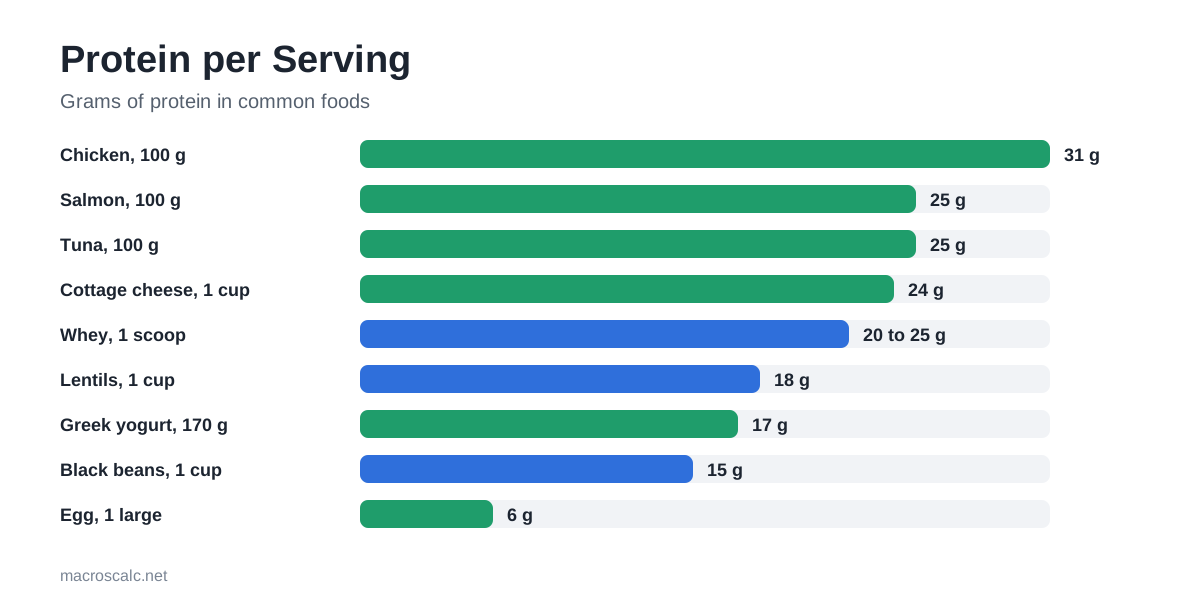
The table shows rounded grams of protein per common serving, based on USDA FoodData Central entries. Exact values vary by brand and preparation, so check labels for packaged foods. Use it to translate your gram target into food.
Food | Typical serving | Protein |
|---|---|---|
Chicken breast, cooked | 100 g (3.5 oz) | About 31 g |
Salmon, cooked | 100 g (3.5 oz) | About 25 g |
Canned tuna, drained | 100 g (3.5 oz) | About 25 g |
Egg, large | 1 egg | About 6 g |
Greek yogurt, plain nonfat | 170 g (6 oz) | About 17 g |
Cottage cheese, low-fat | 1 cup | About 24 g |
Lentils, cooked | 1 cup | About 18 g |
Black beans, cooked | 1 cup | About 15 g |
Firm tofu | 100 g (3.5 oz) | About 8 to 15 g |
Almonds | 28 g (1 oz) | About 6 g |
Whey protein powder | 1 scoop | About 20 to 25 g |
Protein Powders and Supplements
Protein powder is a convenience, not a requirement. If whole foods get you to your target, powder adds nothing special. A scoop is an easy 20 to 25 g when meals fall short, and whey, casein, soy and pea all work.
The chart ranks common foods by protein per serving, which helps when you turn a gram target into meals.
Is More Protein Better? Safety and Upper Limits
More protein is not always better. Above about 2.2 g per kg, extra intake adds little for muscle gain, and it can crowd out carbohydrate that fuels training. In healthy adults, intakes up to about 2 g per kg are well studied and not linked to harm.
Evidence at much higher intakes is thinner, especially over many years. A high intake also does not suit everyone. People with kidney disease, liver disease, a metabolic disorder or a history of disordered eating should not set a protein target from a web page. A clinician or registered dietitian can set a number that fits your lab results and treatment.
Who Should Not Self-Set a High Protein Intake
The ranges on this page are for healthy adults. The same caution applies during pregnancy and breastfeeding, for children and teenagers, and for anyone on a medically supervised diet. It also applies if you take medication that affects appetite or kidney function. This guide is educational and does not replace individual medical advice.
Interpreting Your Protein Number
Treat your answer to how much protein do I need as a range, not a precise prescription. Daily intake varies, and hitting within about 10% of target on most days is close enough. Weigh the number against appetite, budget and how you train. Then adjust after a few weeks.
If your intake is far below target, raise it by 15 to 20 g a day. Add one protein food at a meal. If you are well above 2.2 g per kg, you can usually cut back without losing anything. Spend those calories on carbohydrate for training instead. Tracking helps in the first weeks, and how to count macros shows a simple way to do it.
Common Protein Mistakes
Most mistakes when you ask how much protein do I need come from skipping the units or from copying a number without checking it. Each one below is easy to fix once you spot it. The table lists the errors that most often throw off a protein target.
Mistake | Why it hurts | Fix |
|---|---|---|
Using pounds as if they were kilograms | Overstates the target by more than double | Divide pounds by 2.2 first |
Judging protein by percent of calories | Looks low at high calories and high at low calories | Check grams per kg instead |
Chasing 2.2 g/kg or more by default | Adds cost and calories with little extra benefit | Stay near 1.6 to 2.0 g/kg unless a coach advises otherwise |
Eating most protein at one meal | Makes the daily total harder to reach | Add a protein food to each meal |
Ignoring total calories | Protein cannot offset a poor energy plan | Set calories first, then protein |
Copying a friend’s number | Body weight and goals differ | Calculate how much protein do I need from your own weight and goal |
Writing your weight in kilograms and the g/kg value on the same line avoids the biggest error. If your result looks far from the tables above, recheck your units first.
FAQs
Conclusion
How much protein do I need? It comes down to your weight and goal. The minimum is 0.8 g per kg, and 1.4 to 2.0 g per kg suits most people who train or diet. Multiply your weight in kilograms by the g/kg value, round to whole grams and spread it over your meals.
Run your numbers in the macro calculator to answer how much protein do I need alongside calories, carbohydrate and fat for your goal. If you want the basics first, read what are macros before you start tracking.
Sources
The ranges and figures on this page come from the position statements, meta-analyses and databases below. Food values are rounded from USDA FoodData Central.
Check the original papers if you plan to rely on a specific figure, because ranges differ slightly between reviews.