Carb Cycling: How It Works, Evidence and a Weekly Example
Carb cycling means more carbohydrate on some days and less on others. Weekly calories stay about equal. High days usually land on hard training days. The evidence for it as a fat-loss method is limited, so treat it as a scheduling tool.
This page explains how a cycling week is built and what research says. It gives three worked weeks in grams, plus food lists and common mistakes. To run your own week, use the cycling option in the free macro calculator.

Carb Cycling: What It Is and What Changes
A carb cycling diet alternates higher and lower carbohydrate days across a week. On high days you eat more carbohydrate and a bit more total calories, usually around demanding training. On low days you eat less carbohydrate and fewer calories, and fat takes up some of the slack.
What changes is the shape of the week, not the total. A well-built plan keeps the weekly calorie average at your goal, so a fat-loss plan is still a deficit and a maintenance plan is still maintenance. Protein stays fixed on every day, which is the part of the plan with the strongest support.
Carb Cycling vs Keto and Refeeds
It is not the same as a ketogenic diet, where carbohydrate stays very low every day, often under 50 g. The low days in the examples below still contain nearly 200 g, so they are not keto. It also differs from a refeed, which is a short planned break from a deficit.
A cycling plan is a repeating weekly pattern. It also differs from calorie cycling, where only total energy changes and the macro split stays fixed.
How a Carb Cycling Schedule Is Built
The calculator sets training days at your base calories plus a boost, then lowers rest days so the weekly average does not move. The increase is 10% by default and can be set from 0 to 20%. Rest-day calories follow from one equation.
Rest-day calories = (7 × base calories − training days × training-day calories) ÷ (7 − training days)
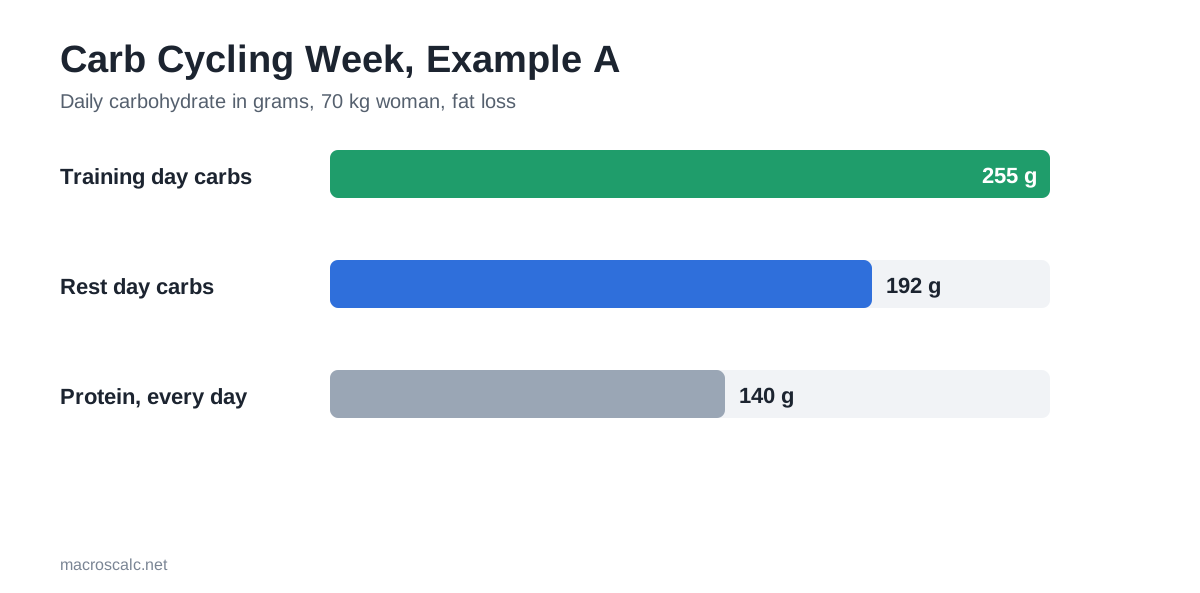
Because protein and fat barely move, almost all of the swing lands on carbohydrate, which is exactly the point of the method. A 10% increase across three training days produces a difference of about 60 g of carbohydrate between a training day and a rest day for a 70 kg woman.
Your baseline carbohydrate and fat come from how many carbs per day and how many grams of fat per day.
The 5:2 Pattern
A simpler version uses five standard days and two higher-calorie days. The calculator labels the two higher days refeed days. The calculator also offers a 5:2 option for this layout.
It suits people who train twice a week or who prefer fewer moving parts. The weekly average still has to match your goal.
What the Evidence Says About Carb Cycling
Direct research is thin. Few controlled trials have tested carb cycling against a steady diet at the same weekly calories, and the ones that exist are small and short.
There is better support for the pieces the method is built from. In the 2009 Sacks trial in the New England Journal of Medicine, people lost similar weight on diets with very different carbohydrate shares. Weekly calories therefore drive fat loss more than the carbohydrate split.
For performance, Burke and colleagues and later Impey and colleagues describe how carbohydrate intake can be matched to the training load. That is the idea behind high-carb training days.
The practical reading is modest. This approach is a reasonable way to fit more fuel into hard sessions and fewer calories into easy days. It has not been shown to burn more fat than a steady plan at the same calories. Early scale changes after a low-carb day are mostly water held with glycogen, not fat.
Benefits of Cycling and What Is Overstated
The realistic benefits are practical. High days put more fuel around hard sessions, and the structure can make a deficit easier to follow. Some people find it easier to eat less on rest days when they know a higher day is coming.
Claims go further than the data. A metabolic reset, better insulin sensitivity and extra fat burning are often promised, but controlled trials have not shown them for cycling itself. Weekly calories, protein and training quality still decide the result.
Who Uses This Approach
It tends to suit people who train three or more days a week, enjoy structure and like to schedule meals around workouts. Lifters and endurance athletes use it because the high days line up with the sessions where carbohydrate helps most.
It pairs well with a recomposition plan, covered in macros for body recomposition.
Lifters in a surplus can start from macros for muscle gain.
A simple decision rule helps. If you train hard on fixed days and tracking does not stress you, cycling is worth a trial. If you train lightly or irregularly, a steady daily plan gives the same weekly total with less effort.
Risks, Side Effects and Who Should Skip It
Low days can bring hunger, low energy and flat sessions if they fall too low. Cutting fruit, grains and starchy vegetables on those days can also leave gaps in fibre and micronutrients. Large swings between days are harder to sustain, so a smaller boost is safer to start.
Skip the method if tracking already feels stressful or if you have a history of disordered eating. A pattern of tight and loose days can reinforce restriction and bingeing. People with diabetes, anyone taking glucose-lowering medication, and those who are pregnant should not change carbohydrate patterns without clinical advice.
Carb Timing Around Workouts
Carb timing is related but separate. Timing means placing carbohydrate before and after training within a day, while cycling changes the totals across days. You can use either or both.
A simple approach is to put most carbohydrate in the meals before and after training on high days. On rest days, keep carbohydrate in moderate amounts from vegetables, fruit and a small portion of starch. Let protein and fat anchor the meals.
A Worked Week With Grams
These weeks use the calculator’s cycling option with a 10% increase and an activity factor of 1.55. Calories start from the Mifflin-St Jeor estimate described in BMR and TDEE. Protein follows the g/kg targets in how much protein per day.
Example A: Carb Cycling for Fat Loss, Woman, 70 kg, 3 Training Days
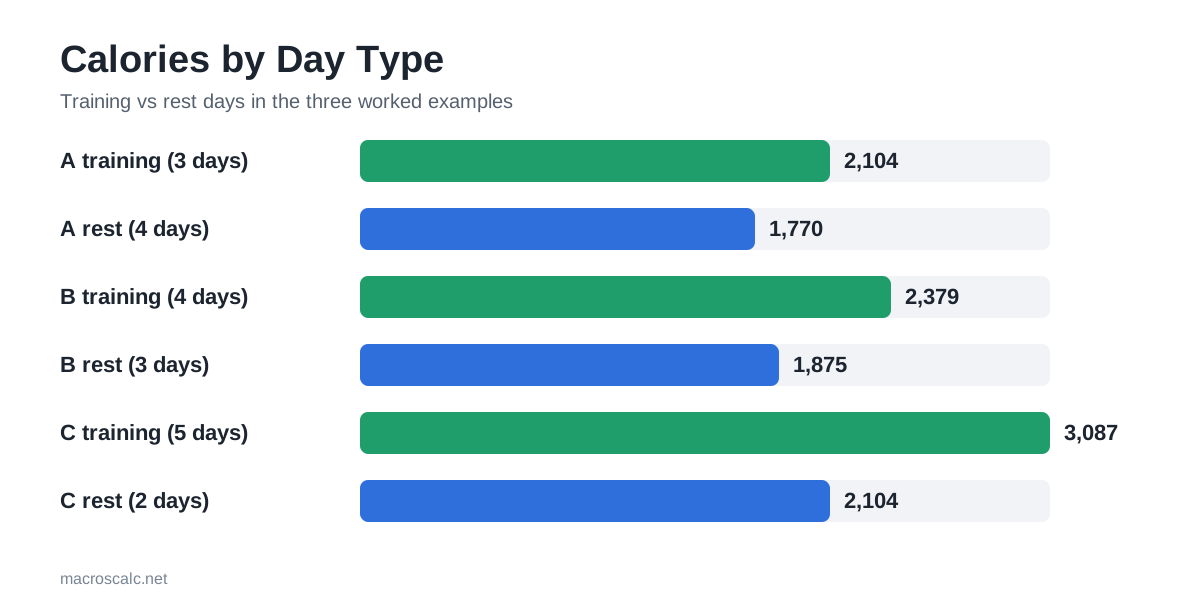
A 35-year-old woman at 165 cm and 70 kg has a maintenance level of 2,163 calories. A fat-loss preset of 0.5 lb a week lowers the base to 1,913. Training days come to 2,104 calories with 140 g protein, 255 g carbohydrate and 58 g fat. Rest days come to 1,770 calories with 140 g protein, 192 g carbohydrate and 49 g fat.
The weekly average is 3 × 2,104 plus 4 × 1,770, divided by 7, which equals 1,913. Carbohydrate is about 3.6 g per kg on training days and 2.7 g per kg on rest days.
Example B: Maintenance, Woman, 70 kg, 4 Training Days
At maintenance with the same profile, the base is 2,163 calories and protein is 112 g. Training days come to 2,379 calories with 304 g carbohydrate and 79 g fat. The three rest days come to 1,875 calories with 216 g carbohydrate and 63 g fat. The weekly average stays at 2,163.
Example C: Maintenance, Man, 82 kg, 5 Training Days
A 28-year-old man at 180 cm and 82 kg has a base of 2,806 calories and 131 g protein. Training days come to 3,087 calories with 409 g carbohydrate and 103 g fat. Rest days come to 2,104 calories with 237 g carbohydrate and 70 g fat.
Five training days leaves only two rest days to absorb the boost, so each rest day drops by about 700 calories. That is a large swing, and for some people a smaller boost of 5% is easier to live with.
Plan | Day type | Calories | Protein | Carbohydrate | Fat |
|---|---|---|---|---|---|
A: fat loss | Training (3 days) | 2,104 | 140 g | 255 g | 58 g |
A: fat loss | Rest (4 days) | 1,770 | 140 g | 192 g | 49 g |
B: maintenance | Training (4 days) | 2,379 | 112 g | 304 g | 79 g |
B: maintenance | Rest (3 days) | 1,875 | 112 g | 216 g | 63 g |
C: maintenance | Training (5 days) | 3,087 | 131 g | 409 g | 103 g |
C: maintenance | Rest (2 days) | 2,104 | 131 g | 237 g | 70 g |
This chart compares calories on training and rest days across the three examples.
Carb Cycling Meal Plan: A Sample Week
A plan is easier to follow when it is written as a week. The table is a 7 day carb cycling plan that maps Example A onto seven days with training on Monday, Wednesday and Friday. Calories and carbohydrate come from the worked week above.
The food ideas are examples, not a prescription. Swap in what you like, and use the foods table below to hit the grams.
Day | Type | Calories | Carbohydrate | Meal focus |
|---|---|---|---|---|
Monday | Training | 2,104 | 255 g | Oats and banana, chicken and rice, post-workout whey and fruit, salmon and sweet potato |
Tuesday | Rest | 1,770 | 192 g | Eggs and berries, chicken salad with beans, Greek yogurt and almonds, fish with vegetables |
Wednesday | Training | 2,104 | 255 g | Oats and banana, tuna and pasta, post-workout whey and fruit, chicken and potatoes |
Thursday | Rest | 1,770 | 192 g | Eggs and avocado, turkey and lentil soup, cottage cheese, tofu stir-fry |
Friday | Training | 2,104 | 255 g | Yogurt with oats, chicken and rice, banana before training, salmon and sweet potato |
Saturday | Rest | 1,770 | 192 g | Omelette and fruit, tuna salad, nuts and yogurt, lean beef with vegetables |
Sunday | Rest | 1,770 | 192 g | Eggs and toast, chicken and quinoa, fruit and yogurt, fish with vegetables |
High-Carb and Low-Carb Foods for Cycling Days
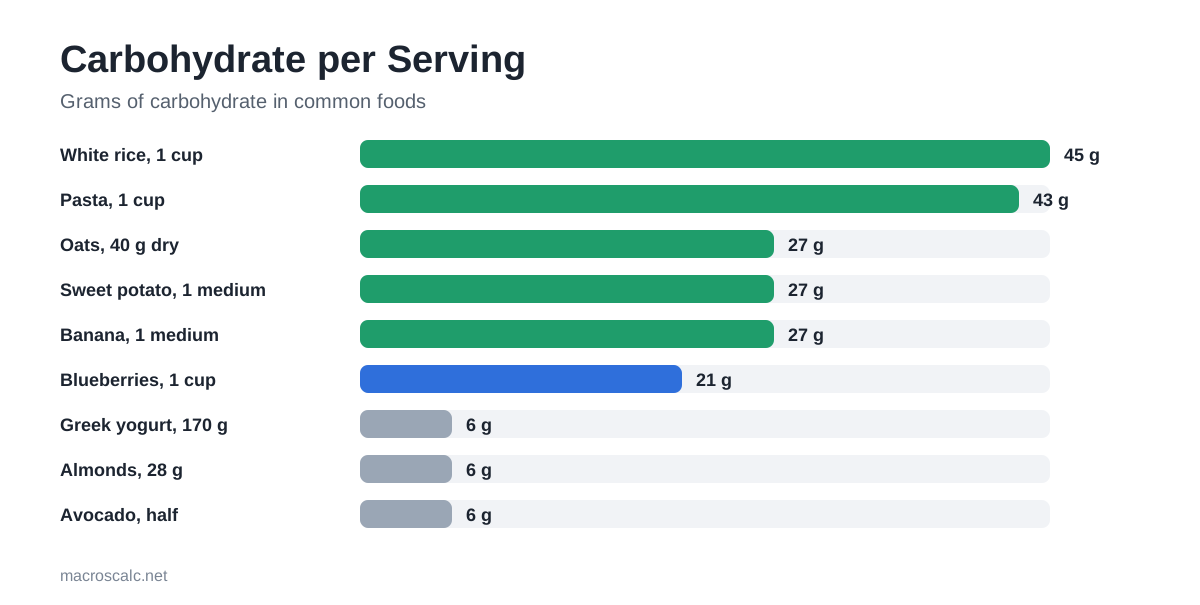
Food choices matter less than grams, but a short list helps you build high and low days. The table gives approximate carbohydrate per common serving from USDA FoodData Central. Values vary by brand and preparation.
Use the high-day foods around training and the low-day foods to keep protein and fat steady. Fruit and legumes work on either day when portions are adjusted.
Food | Serving | Carbohydrate | Best for |
|---|---|---|---|
Rolled oats, dry | 40 g (half cup) | About 27 g | High day |
White rice, cooked | 1 cup | About 45 g | High day |
Brown rice, cooked | 1 cup | About 45 g | High day |
Pasta, cooked | 1 cup | About 43 g | High day |
Baked sweet potato | 1 medium | About 27 g | High day |
Banana | 1 medium | About 27 g | High day |
Blueberries | 1 cup | About 21 g | Either |
Greek yogurt, plain nonfat | 170 g (6 oz) | About 6 g | Low day |
Almonds | 28 g (1 oz) | About 6 g | Low day |
Avocado | Half | About 6 g | Low day |
Eggs, chicken, fish | Typical portion | Under 1 g | Low day |
Green bars mark high-day foods, blue marks foods that work on either day, and gray marks low-day foods.
Interpreting Your Numbers
Judge a cycling plan by the weekly average and your trend, not by any single day. If your weight and energy are stable across two to three weeks, the plan is working as intended. If hard sessions feel flat on training days, add carbohydrate before them before changing anything else.
If you feel poorly on rest days, raise carbohydrate to a moderate level or reduce the boost. A smaller swing is a sensible choice for people new to cycling. If you are not training much, a steady daily plan is simpler and gives the same weekly total.
Using the Calculator’s Cycling Option
In the macro calculator, choose your goal, set Calorie & macro cycling to Training vs. Rest Days and enter your training days. The tool applies the training-day calorie increase, lowers rest days and shows both sets of macros. It also checks that rest-day calories do not fall below the safety floor, and warns you if they do.
For the full macro method behind those numbers, read how to calculate macros. If you are cutting, macros for weight loss covers rate and deficit. If you are gaining, see macros for muscle gain.
Common Mistakes With High and Low Days
Most cycling mistakes come from treating the plan as magic. It is a schedule, and the weekly average still decides the result. The table lists the errors that undo a plan most often.
Mistake | Why it hurts | Fix |
|---|---|---|
Raising training-day calories without lowering rest days | The weekly total creeps up | Keep the weekly average equal to base |
Changing protein between days | Loses the most reliable part of the plan | Keep protein the same every day |
Boost too large | Rest days become very low | Use 5 to 10% |
Treating low days as punishment | Can trigger overeating | Keep rest days at a reasonable level |
Judging by one weigh-in | Water shifts hide the trend | Compare weekly averages |
Expecting extra fat loss from carb cycling | No trial shows it | Expect the same result as a steady deficit |
If you track meals, how to count macros shows a simple way to log both day types. Check the weekly average rather than each day.
FAQs
Conclusion
Carb cycling is a way to schedule carbohydrate across a week while keeping weekly calories on target. It fits people who train often, and its fat-loss advantage over a steady plan is unproven.
If you want to try it, set a 10% increase in the macro calculator, keep protein fixed and judge the plan by your weekly trend. If the structure does not help, a steady plan works just as well. For the basics, read what are macros.
Sources
The evidence summary and figures on this page come from the papers below and from USDA FoodData Central. Check the originals if you plan to rely on a specific number. Sacks and the sports nutrition reviews carry most of the weight here, because no trial tests carb cycling directly.