Macros for Weight Loss: Ratios and Cutting Targets in Grams
Macros for weight loss start with a calorie target, which is then split into protein, carbohydrate and fat. The calories set how fast you lose, and the macros protect muscle and keep you full. A common range is a deficit of 500 to 750 calories a day, roughly 1 to 2 pounds a week for most adults. It fits healthy adults with weight to lose, not people with a medical condition or a history of disordered eating.
This page gives the method and three worked profiles with real numbers. It also covers common splits in grams and a table of the mistakes that stall a cut. For your own targets, set a goal in the free macro calculator and pick a weekly rate.

Macros for Weight Loss: What Changes in a Deficit
Weight loss comes from eating fewer calories than you burn, and macros for weight loss decide what that smaller budget is made of. In a 2-year trial, people lost similar weight on diets with very different fat, protein and carbohydrate mixes. What the diets had in common was a calorie reduction (Sacks et al., N Engl J Med 2009;360:859-873). So the order of work is calories first, then protein, then the carbohydrate and fat split.
Macros to lose weight and macros to lose fat still matter inside the deficit for three reasons. Protein helps you keep muscle while the scale drops. Protein and fibre-rich carbohydrate make a smaller budget easier to live with, and enough fat keeps hormones and vitamin absorption on track. For the definitions, see what are macros.
How Big a Deficit? Rate, Floors and Why They Exist
The CDC describes a gradual, steady pace of about 1 to 2 pounds a week as the one most likely to keep weight off. The 2013 AHA/ACC/TOS guideline for adults with overweight or obesity prescribes a deficit of 500 or 750 calories a day. The alternative is a set intake of 1,200 to 1,500 calories for women and 1,500 to 1,800 for men. It reserves diets under 800 calories for medical supervision (Jensen et al., Circulation 2014;129(25 Suppl 2):S102-S138). A 500-calorie daily deficit is roughly a pound a week by the usual 3,500-calorie rule. That rule overstates long-run loss because the body adapts (Hall et al., Lancet 2011;378:826-837).
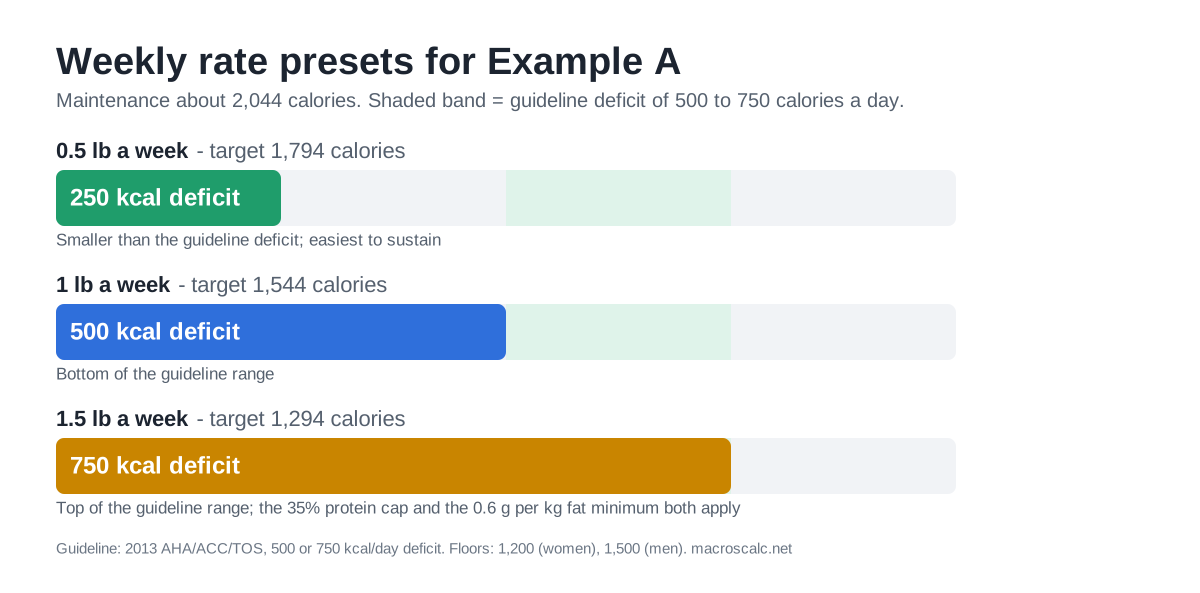
This tool’s calorie floors, 1,200 for women and 1,500 for men, match the lower end of those intake ranges. Its weekly presets of 0.5, 1 and 1.5 pounds correspond to deficits of about 250, 500 and 750 calories. The 1.5-pound preset sits at the top of the 500 to 750 range. It suits people with a high maintenance intake, not someone close to their goal weight. When the target would fall below a floor, the tool raises it to the floor and shows a flag. Eating much less makes enough protein and micronutrients hard to reach.
A weekly rate becomes a timeline by simple division. Losing 10 kg (about 22 lb) takes roughly 44 weeks at 0.5 lb a week, 22 weeks at 1 lb and 15 weeks at 1.5 lb. That is before any allowance for plateaus. A rate is not a deadline, so expect real timelines to run longer than the arithmetic.
Macros for Weight Loss: Protein and Fat First, Carbs Fill the Rest
The method behind macros for weight loss is simple. Set protein from body weight, set fat as a share of calories with a minimum per kilogram, and let carbohydrate take what is left. This tool uses 2.0 g of protein per kg of body weight for fat loss. That is the top of the 1.4 to 2.0 g per kg range in the International Society of Sports Nutrition position stand (Jäger et al., J Int Soc Sports Nutr 2017;14:20). Fat is set at 25% of calories. In a meta-analysis of resistance training, gains in lean mass stopped rising above about 1.6 g per kg a day (Morton et al., Br J Sports Med 2018;52:376-384). So going far past 2.0 g adds little.
The arithmetic is the same every time, and how to calculate macros shows each step, so this page does not repeat it. Protein is capped at 35% of calories, because at low calorie totals a fixed grams-per-kg target would otherwise crowd out everything else.
Using the Calculator to Set Macros for Weight Loss
In the free macro calculator, pick a weekly loss rate of 0.5, 1 or 1.5 pounds, and enter your stats and an activity level. The tool returns calories, protein, carbohydrate and fat. It applies the calorie floor, the 35% protein cap and the fat minimum before it shows a result. It lists a flag whenever one of them changes your numbers.
Treat the result as a starting point, not a verdict. Run it again after about 5 kg of loss or a change in routine, because a lighter body burns less. Keep the goal on a loss rate while you cut.
Diet Quality and Macros for Weight Loss
Hitting grams is not the same as eating well. Build protein from lean meat, fish, eggs, dairy, legumes and tofu, and choose carbohydrate sources that bring fibre, such as oats, beans, fruit, potatoes and whole grains. Fibre and bulky foods help a smaller calorie budget feel larger, which makes adherence easier than the macro split itself.
For gram targets by calorie level, see how many carbs per day and how many grams of fat per day.
Why Protein Comes First in a Deficit
Protein is the one macro where a bigger number has a clear job. In a deficit the body loses some lean mass along with fat, and a higher protein intake helps limit that loss, especially alongside resistance training. A meta-analysis of energy-restricted diets found that higher-protein versions produced greater fat loss and better lean-mass retention than standard-protein versions (Wycherley et al., Am J Clin Nutr 2012;96:1281-1298).
If you lift and want to lose fat at maintenance calories instead, see macros for body recomposition.
Protein also helps with fullness. It costs more energy to digest than the other two macros: roughly 20 to 30% of its calories, against 5 to 10% for carbohydrate and 0 to 3% for fat (Halton and Hu, J Am Coll Nutr 2004;23:373-385). In Example A that is about 110 to 170 of the 560 protein calories. It is a small edge, so it supports the deficit and does not replace it.
Macros for Weight Loss: Protein per Meal and Where It Comes From
Spreading protein over three or four meals works better than one large serving. A review of the evidence suggests about 0.4 g per kg of body weight per meal across four meals (Schoenfeld and Aragon, J Int Soc Sports Nutr 2018;15:10). That is about 28 g for a 70 kg adult. Example A’s 140 g works out to roughly 35 g across four meals, a little above that guide because the tool sets protein at 2.0 g per kg.
Eggs, Greek yogurt, fish, poultry, lean beef, tofu and legumes are the usual sources. Check labels for the grams, since portions vary widely, and see the how to count macros guide for logging them.
Macro Ratios for Weight Loss: Common Splits in Grams
People often ask for macros for weight loss as a percentage split, known as a macro ratio for weight loss. Three common ones, protein / carbohydrate / fat, are shown below at 1,794 calories, the half-pound-a-week target in Example A. A percentage split is a template, and a grams-per-kg protein target is usually the better anchor at low calories.
Split (protein / carbohydrate / fat) | Protein (g) | Carbohydrate (g) | Fat (g) |
|---|---|---|---|
25 / 50 / 25 | 112 | 224 | 50 |
30 / 40 / 30 | 135 | 179 | 60 |
35 / 35 / 30 | 157 | 157 | 60 |
All three sum to 1,794 calories within rounding. The 35 / 35 / 30 split matches the high-protein approach best, while 25 / 50 / 25 leaves more room for carbohydrate if you train hard.
When the diet ends, reverse dieting shows how to raise calories back to maintenance in steps.
Macros for Weight Loss: Cut Carbs or Fat First?
Once protein is fixed, the deficit has to come out of carbohydrate, fat or both. Fat is more energy-dense at 9 kcal per gram, so a small gram cut in fat saves more calories than the same cut in carbohydrate. Even so, adherence usually decides the better choice, so cut the macro whose foods you miss least, and keep fat above the floor.
Trial evidence agrees. In a 12-month trial of 609 adults, a healthy low-fat diet and a healthy low-carbohydrate diet produced similar weight loss. The average losses were about 5.3 kg and 6.0 kg, with no significant difference between them (Gardner et al., JAMA 2018;319:667-679). So the sound approach is to keep protein fixed and choose the carbohydrate-to-fat balance you can sustain.
This is also why the calorie target comes first. Hitting the right total with an imperfect split still beats a perfect split at the wrong total.
Macros for Weight Loss on Training Days and Rest Days
Macros can stay the same every day, and for most people that is the simplest plan. If you prefer to eat more on training days, move carbohydrate and leave protein and fat alone. For Example A, three training days sit at 1,874 calories (140 g protein, 216 g carbohydrate, 50 g fat). Four rest days sit at 1,734 calories (140 g, 181 g, 50 g). Together they average exactly 1,794 calories a week.
The weekly average is what drives the deficit, so the split is about performance and appetite, not extra fat loss. Skip it if it makes tracking harder.
Macros for Weight Loss: Example Splits for Three Profiles
The three profiles of macros for weight loss below use the same engine as the calculator (Mifflin-St Jeor for BMR, an activity factor for maintenance, then a deficit). Each one ends with what to change at the two-week check. These are examples of how the tool behaves, not advice for any individual.
Example A is the standard case, Example B shows the 35% protein cap at a faster rate, and Example C shows the calorie floor. Only the inputs differ between them, so any gap in the grams comes from stats, rate or a safeguard, not from a different method.
Example A: Macros for Weight Loss at a Moderate 0.5 lb a Week
A woman aged 35, 165 cm, 70 kg, moderately active (activity factor 1.465). BMR is 1,395 calories and maintenance is about 2,044. The half-pound-a-week preset subtracts 250, giving 1,794 calories: 140 g protein, 196 g carbohydrate and 50 g fat. The default fat-loss mode (a 20% deficit) gives 1,635 calories: 140 g, 167 g and 45 g.
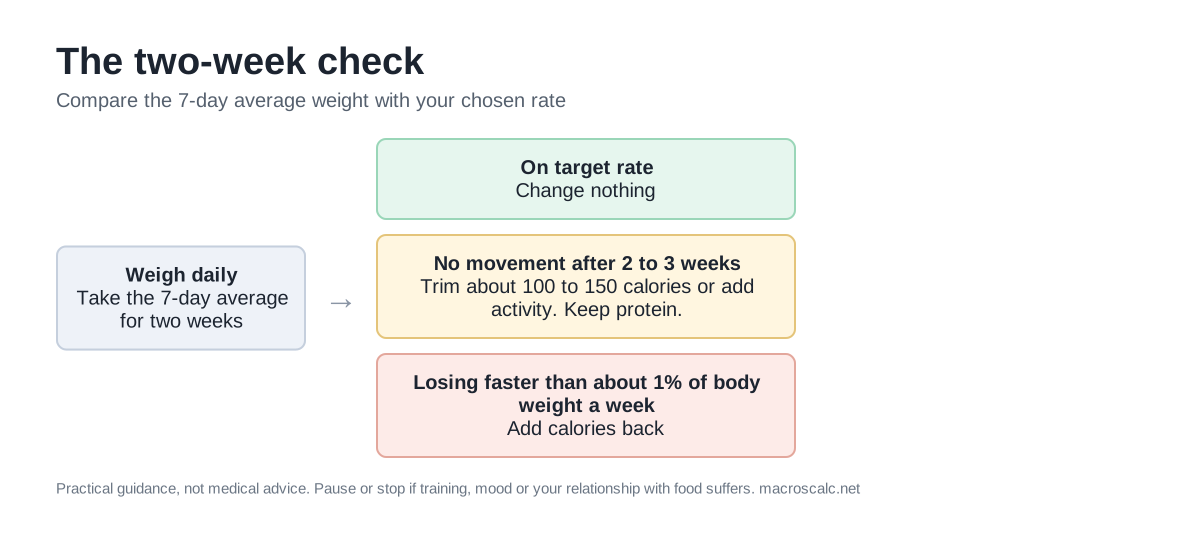
Protein stays at 140 g (2.0 g per kg) in both cases, and the deficit comes out of carbohydrate and fat. At the two-week check, if the 7-day average weight has not moved, trim about 100 calories from carbohydrate or add daily steps before touching protein.
Example B: Macros for Weight Loss at a Faster 1 lb a Week
The same woman at the 1 lb preset: 2,044 minus 500 is 1,544 calories. Protein would be 140 g at 2.0 g per kg, but that is 36% of calories. The 35% cap lowers it to 135 g (1.9 g per kg), with 154 g carbohydrate and 43 g fat. The tool shows a flag when the cap applies.
The cap is the tool telling you the deficit is large relative to maintenance. A 500-calorie deficit sits inside the guideline range, but it leaves less room for carbohydrate, so watch energy and training quality. If either drops, move back to the half-pound preset.
Example C: Macros for Weight Loss and the Calorie Floor
A woman aged 50, 155 cm, 50 kg, sedentary (activity factor 1.2), with a fat-loss goal. The calculation lands at 1,015 calories, which is below the 1,200-calorie floor. The tool raises the target to 1,200: 100 g protein, 125 g carbohydrate and 33 g fat, and shows a flag.
The floor exists because very low intakes make it hard to cover protein and micronutrients. If a goal needs less than the floor, change something else: add movement, choose a slower rate, or accept a longer timeline. A person who is small and sedentary may simply have a modest deficit available, and that is normal.
How to Interpret Your Results and Adjust After Two Weeks
Judge progress by the 7-day average of daily weights, not one morning, because water shifts of a pound or two are routine. Compare the last two weeks of averages with your chosen rate. If you are losing close to the target rate, change nothing.
If the average has not moved after two to three weeks of honest tracking, reduce calories by about 100 to 150 or raise activity. Keep protein where it is. If you are losing faster than about 1% of body weight a week, add calories back, since a faster cut tends to cost more muscle and energy. Stop or pause the cut when your target is reached, when training or mood is suffering, or if you notice an unhealthy focus on food. Speak to a doctor or dietitian if that happens.
What to Do When Weight Loss Stalls
When macros for weight loss seem to stop working, first confirm that you have actually stalled: the 7-day average has not moved for two to three weeks. Then work down this list in order and change one thing at a time, so you can tell what helped.
Most stalls resolve at step 1 or 2. If weight is still flat after all five steps and you are already at your calorie floor, stop cutting. Speak to a doctor or dietitian rather than lowering calories further.
Who Needs a Different Approach?
The method on this page suits healthy adults. Women in menopause, older adults and people who train hard may need different protein, calorie or recovery targets. Treat the output as a starting point and adjust from your own results.
See a doctor or registered dietitian before cutting calories if you are pregnant or have a medical condition. The same goes for medication that affects appetite or blood sugar (including GLP-1 drugs) and for a history of disordered eating. A professional can set targets that the calculator cannot.
Macros for Weight Loss for Women and Menopause
Women get a 1,200-calorie floor in this tool, and hormonal changes around perimenopause and menopause can alter body composition and recovery. Muscle mass tends to fall with age, which makes protein at the upper end of the range and regular resistance training more important, not less. Evidence for a special macro ratio in menopause is limited, so be wary of fixed splits sold for it and judge your plan by two-week trends.
Macros for Weight Loss in Older Adults
Healthy older adults are advised to eat at least 1.0 to 1.2 g of protein per kg a day, with more during illness or when training (Bauer et al., J Am Med Dir Assoc 2013;14:542-559). This tool’s 2.0 g per kg default sits above that baseline. That suits most healthy people, but anyone with kidney disease should get a protein target from a clinician. Keep the deficit gentle at the 0.5 lb preset and pair it with resistance training to protect strength.
Macros for Weight Loss When You Have a Lot to Lose
The tool sets protein from actual body weight, so at high weights the 2.0 g per kg default can become impractical, and the 35% cap then limits it. A woman aged 40, 170 cm and 120 kg at moderate activity has maintenance of about 2,786 calories. At the 1 lb preset her target is 2,286 calories. That is 200 g protein (1.7 g per kg, held by the cap), 209 g carbohydrate and 72 g fat (raised to the 0.6 g per kg minimum). Protein at 1.7 g per kg is still inside the studied range, so the cap here is the tool avoiding an oversized target, not a problem to fix.
Macros for Weight Loss for Beginners
If counting four numbers feels like too much, start with calories and protein only and add fat and carbohydrate targets later. Weigh food for two weeks to calibrate portion sizes, then move to estimates. The how to count macros guide covers the routine.
Macros for Weight Loss on GLP-1 Medicines
Medicines in the GLP-1 class reduce appetite, which makes protein targets harder to reach and protecting lean mass more important. Small, protein-first meals, enough fluid and resistance training are the usual priorities, but dosing and nutrition decisions belong with the prescriber or a dietitian. The calculator’s output is a starting point and not a plan for anyone on these drugs.
Sample Day: How the Macros Split Across Meals
Macros are easier to hit when each meal has a budget. The table splits Example A’s 1,794 calories (140 g protein, 196 g carbohydrate, 50 g fat) across four eating slots, with protein spread evenly.
Meal | Protein (g) | Carbohydrate (g) | Fat (g) | Calories |
|---|---|---|---|---|
Breakfast | 35 | 45 | 12 | 428 |
Lunch | 35 | 55 | 14 | 486 |
Snack | 35 | 30 | 6 | 314 |
Dinner | 35 | 66 | 18 | 566 |
Day total | 140 | 196 | 50 | 1,794 |
The slots are a template, not a rule. Move carbohydrate to the meal around training, or merge the snack into dinner, and keep the day’s totals the same.
For a full logged day, with each meal’s protein, carbohydrate and fat added to a running total, see the sample day in the how to count macros guide.
Eating Out While Following Macros for Weight Loss
Eating out is where macro tracking slips, because oils, sauces and portion sizes are hidden. Choose a protein-first main, ask for sauces on the side, and enter the closest match from a menu or database rather than skipping the meal. A rough entry still beats no entry, and the weekly average is what counts.
Habits That Make the Macros Easier to Keep
Macros set what you eat, but a few habits decide whether you can keep eating it. None of them changes the calorie arithmetic, and each one either makes the plan easier to follow or protects muscle while the scale drops.
Most of the benefit comes from lifting weights, eating enough fibre and sleeping enough. Walking is a useful fourth, because it adds a deficit without touching your food targets.
Resistance Training and Macros for Weight Loss
Lifting two to three times a week gives the protein in your plan something to protect. Without a training signal, a larger share of the weight you lose can be lean mass. Progressive overload on the main lifts is enough, and consistency matters more than the programme.
Fibre, Fullness and Macros for Weight Loss
The Institute of Medicine’s adequate intake is 14 g of fibre per 1,000 calories, which is about 25 g at 1,794 calories. Vegetables, fruit, oats, beans and whole grains reach it while keeping portions large for the calories. Raise fibre gradually and drink water with it to avoid discomfort.
Sleep and Macros for Weight Loss
In a 14-day trial of overweight adults on the same calorie restriction, 5.5 hours in bed instead of 8.5 cut the fat lost by more than half. It also increased the loss of lean mass and raised hunger (Nedeltcheva et al., Ann Intern Med 2010;153:435-441). Treat sleep as part of the plan, because it changes what the same deficit does.
Daily Movement and Macros for Weight Loss
Daily movement outside workouts varies a lot between people and tends to fall as a deficit continues. A step count you can track, raised by a few thousand steps a day, is the easiest lever to pull before cutting calories further. Do not eat back the exercise calories a watch reports unless you want to cancel the deficit.
Managing Hunger on a Macros for Weight Loss Plan
When hunger is the main problem, change the food before you change the targets. Raise protein toward the top of the range, and add fibre and high-volume foods such as vegetables, fruit and broth-based soups. Spread calories so that no meal is very small.
If hunger is still hard to manage after two weeks, move to a slower preset. The 0.5 lb rate, 250 calories below maintenance, is a legitimate plan, and the best version of a plan is the one you can keep up.
Safety Notes
This page explains how a calculator sets macros for weight loss in a calorie deficit and is not medical advice. Do not use a deficit if you are pregnant or breastfeeding, under 18, or have a history of disordered eating, and get targets from a doctor or registered dietitian if you have diabetes, kidney disease or another medical condition, or take medication that affects appetite or blood sugar.
The tool’s floors of 1,200 and 1,500 calories are lower bounds taken from guideline ranges, not targets to aim for. Stop and seek advice if you feel faint, lose your period, cannot recover from training, or find that tracking food causes distress.
Common Mistakes in a Deficit
Most stalls come from a handful of repeatable errors rather than from the macro split. The table lists the ones that matter most and what to do instead.
Mistake | Why it stalls or backfires | Fix |
|---|---|---|
Going below the calorie floor | Protein and micronutrients become hard to cover, and adherence drops | Use a slower preset or add activity |
Setting protein as a percentage only | At low calories the grams come out too small | Anchor protein to grams per kg |
Judging progress from one weigh-in | Water shifts hide the trend | Use the 7-day average |
Never updating the estimate | Weight loss lowers maintenance, and activity changes | Recalculate after about 5 kg or a change in routine |
Under-logging oils, sauces and drinks | Small items add up to a few hundred calories | Weigh and log them |
Cutting fat to a minimum | Hormones and vitamin absorption can suffer | Keep fat at least 0.6 g per kg, as the tool does |
Eating back exercise calories | Device estimates are imprecise and can overstate, which cancels the deficit | Do not add them back; let the weekly trend decide |
Weekend overshoot | A few loose days can cancel much of a week’s deficit | Plan weekend meals and log them |
Forgetting alcohol | Alcohol supplies about 7 calories per gram and is easy to leave unlogged | Log drinks, or budget them from carbohydrate or fat |
Expecting a straight line | Weight moves in steps because of water shifts | Judge progress by the 7-day average over several weeks |
Most of these mistakes are fixed by tracking better, not by cutting harder. Lowering calories further is the usual instinct and usually the wrong move, because it pushes protein and micronutrients down while the real cause is an unlogged item or a short window. Check the log and the two-week average first.
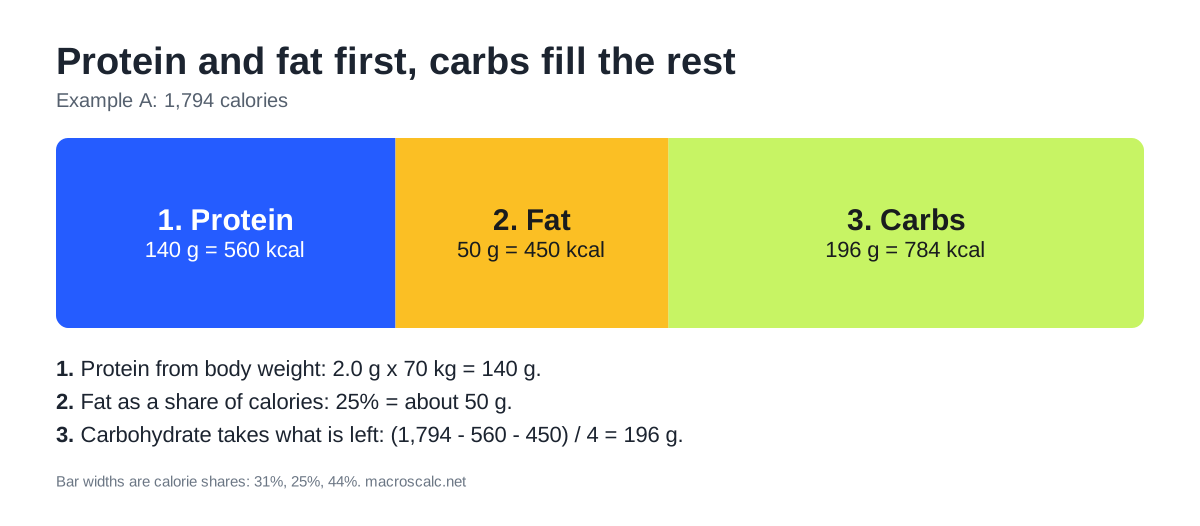
Comparison: Weekly Rate Presets for Example A
The presets change only the calorie target, so comparing them on one profile shows the trade-off. The profile is Example A, with maintenance of about 2,044 calories.
Macros for weight loss preset | Daily deficit | Target calories | Fit |
|---|---|---|---|
0.5 lb a week | 250 | 1,794 | Smaller than the guideline deficit; easiest to sustain |
1 lb a week | 500 | 1,544 | Bottom of the 500 to 750 guideline range |
1.5 lb a week | 750 | 1,294 | Top of the 500 to 750 guideline range; the 35% protein cap and the 0.6 g per kg fat minimum both apply |
The 0.5 lb preset suits most people who want the least disruption, and the 1.5 lb preset suits those with a lot to lose. The 1 lb preset is where the protein cap first appears for Example A, so read its flag before choosing it.
FAQs
Conclusion
Macros for weight loss work in a fixed order: choose a sustainable deficit, set protein from body weight, keep fat above a minimum and let carbohydrate fill the rest. The examples show how the numbers change with the rate and why the floor and the protein cap exist.
To get macros for weight loss that fit your own body and goal, use the free macro calculator, then follow how to count macros to track them. For the arithmetic behind the tool, see how to calculate macros.