Basal Metabolic Rate: What Is BMR, TDEE and How to Calculate
What is BMR? Basal metabolic rate is the energy your body burns at complete rest to keep you alive: breathing, circulation, temperature control and cell repair. Total daily energy expenditure, or TDEE, builds on that figure by adding the energy you spend moving, training and digesting food. BMR is the floor, and TDEE is the number that decides what keeps your weight steady.
This page walks through both numbers at formula level. It covers the six activity levels the calculator uses, two worked profiles with every step printed, and a table that separates BMR, RMR and TDEE. The focus is on what the figures mean and how to read them. When you want your own numbers, the macro calculator runs the same steps and turns TDEE into daily protein, carbs and fat.

What Is BMR? Basal Metabolic Rate Explained
BMR, short for basal metabolic rate, is the number of calories your body uses in 24 hours at complete rest. It covers only the work needed to stay alive, with no movement, no digestion and no exercise on top. What does BMR mean in practice? It is the floor of your daily energy use, before anything else is added.
What is BMR made of? BMR includes your heartbeat, breathing, blood circulation, body temperature, brain activity and tissue upkeep. It excludes everything you do: walking, working, training, fidgeting and the energy spent digesting meals. That is why BMR is always lower than the calories you burn in a real day.
So what is BMR for your daily calories? It is a baseline, not a budget. For most adults it is the largest single part of daily energy use. At a sedentary factor of 1.2, BMR is 83% of TDEE, and at the highest factor of 1.9 it is still 53%.
What Is BMR vs RMR? A Measurement Distinction
What is BMR in a lab? True BMR is measured under strict conditions: just after waking, fasted for about 12 hours, lying still in a thermoneutral room. Resting metabolic rate (RMR) is measured under looser conditions and usually reads slightly higher. Most calculators that say BMR are really predicting RMR, because the Mifflin-St Jeor equation was fitted to resting measurements.
The gap between the two is small next to the error in the activity multiplier. For macro targets this site treats them as interchangeable and uses the word BMR throughout.
What Is BMR Times Activity? Turning BMR Into TDEE
What is TDEE? Total daily energy expenditure is the calories you burn across a full day: your BMR plus everything else. The everything-else has three parts: deliberate exercise, everyday movement such as walking and standing, and the energy used to digest food.
The link between BMR and TDEE is multiplication, not addition. TDEE equals BMR times an activity factor, and that one factor stands in for all three parts at once. The calculator’s factor also covers occupational movement and the thermic effect of food, which is why it is a single multiplier and not a list of separate terms.
The multiplier is an estimate, not a measurement. Two people with the same BMR and the same label can differ by several hundred calories a day. The label describes a pattern of exercise, not what it actually costs. Treat the factor as a starting point and check it against your weight trend over two to three weeks.
How to Calculate TDEE
To calculate TDEE, multiply your BMR by the factor for your activity level. Pick the level that matches your average week, not your best week.
TDEE = BMR × fThe six levels below are the exact options in the calculator’s dropdown. The last column shows how much of TDEE is BMR (1 divided by the factor), which falls as activity rises.
Activity level (calculator wording) | Factor f | BMR as share of TDEE |
|---|---|---|
Sedentary: little to no exercise | 1.2 | 83% |
Light: exercise 1 to 3 times a week | 1.375 | 73% |
Moderate: exercise 4 to 5 times a week (default) | 1.465 | 68% |
Active: daily exercise or 3 to 4 intense sessions | 1.55 | 65% |
Very Active: intense exercise 6 to 7 times a week | 1.725 | 58% |
Extra Active: intense physical job or 2 sessions a day | 1.9 | 53% |
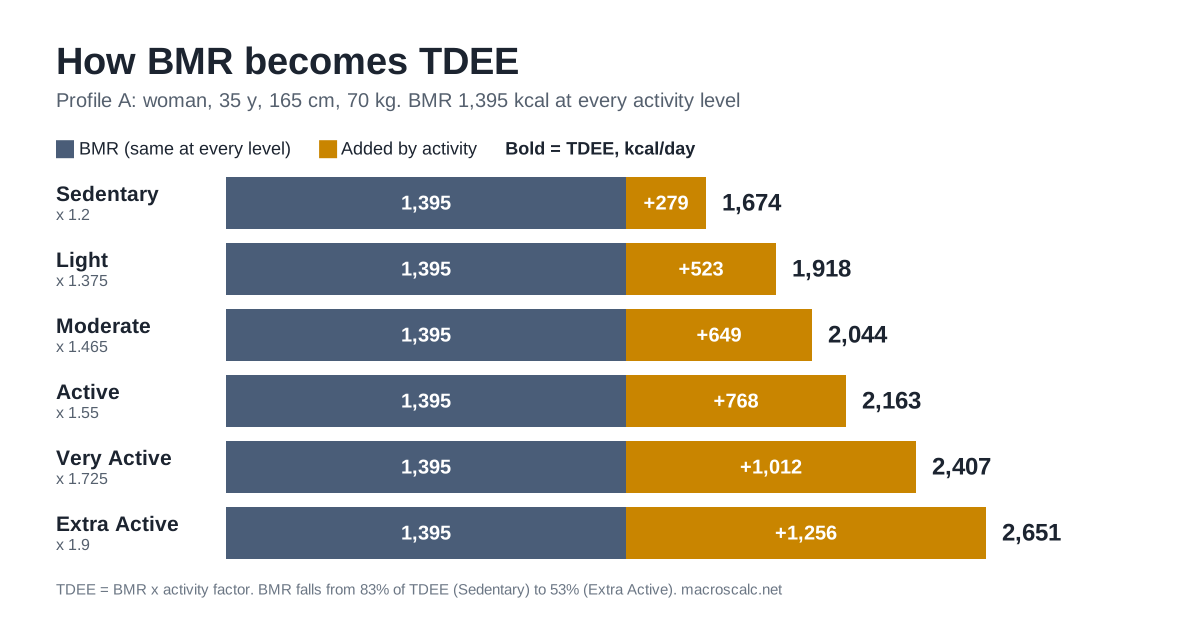
The factors apply to the equation’s BMR output, so they only mean something relative to it. The worked examples below show the same table with real calories for two profiles.
What Changes Your BMR
What drives it? Four inputs drive a predicted BMR: body weight, height, age and sex. In the Mifflin-St Jeor equation each kilogram adds 10 kcal a day, each centimetre of height adds 6.25, and each year of age subtracts 5. The sex term adds 5 for men or subtracts 161 for women.
Different equations give different results, and BMR equations compares them.
What does that look like for a real person? Take Profile A, a 35-year-old woman at 165 cm and 70 kg with a BMR of 1,395 kcal. Ten more years of age lowers it by 50 kcal. Five more kilograms raises it by 50 kcal, and five more centimetres of height raises it by 31 kcal.
What does the estimate miss? The equations cannot see body composition, genetics, thyroid and other hormones, recent weight change or illness. Two people with identical inputs can land about a tenth apart in either direction. When body fat is known, the Katch-McArdle equation, which uses lean mass, predicts better, and the calculator switches to it when you enter body fat.
What Is BMR for a Typical Adult? Normal Values
There is no single normal value, because BMR scales with body size, age and sex. The table shows what the Mifflin-St Jeor equation returns for six sample adults. These are equation outputs for illustration, not population norms or measured values.
Sample adult | Height | Weight | Mifflin-St Jeor BMR |
|---|---|---|---|
Woman, 25 | 160 cm | 55 kg | 1,264 kcal |
Woman, 35 | 165 cm | 70 kg | 1,395 kcal |
Woman, 55 | 168 cm | 80 kg | 1,414 kcal |
Man, 28 | 180 cm | 82 kg | 1,810 kcal |
Man, 40 | 175 cm | 75 kg | 1,649 kcal |
Man, 60 | 172 cm | 90 kg | 1,680 kcal |
A heavier body usually raises BMR, while each added year lowers the equation’s result by 5 kcal. So a result well away from these ranges is not a problem by itself. Use your own number as a planning baseline, then check it against real weight change over several weeks.
Can You Raise Your BMR?
How much room is there for change? Only a little, and not quickly. Lean mass is the main lever. In the Katch-McArdle equation each kilogram of lean mass adds about 21.6 kcal a day, so 2 kg of added muscle is worth roughly 43 kcal. That is small next to what the training itself burns, which the activity factor already counts.
Two cautions follow. Large, prolonged calorie cuts can push real expenditure below the predicted value, so recheck your numbers if weight stalls. And no food, drink or supplement has earned the label metabolism booster.
What Is BMR Used For? Feeding the Macro Calculation
What is BMR‘s role in the macro calculation? BMR is the first input in a four-step chain that ends in grams of protein, carbs and fat. BMR and TDEE are inputs to the plan, not goals in themselves: the calorie target comes from TDEE, and the grams come from the target.
Here is the chain for Profile A (35-year-old woman, 165 cm, 70 kg, Moderate activity) on the calculator’s default fat-loss setting.
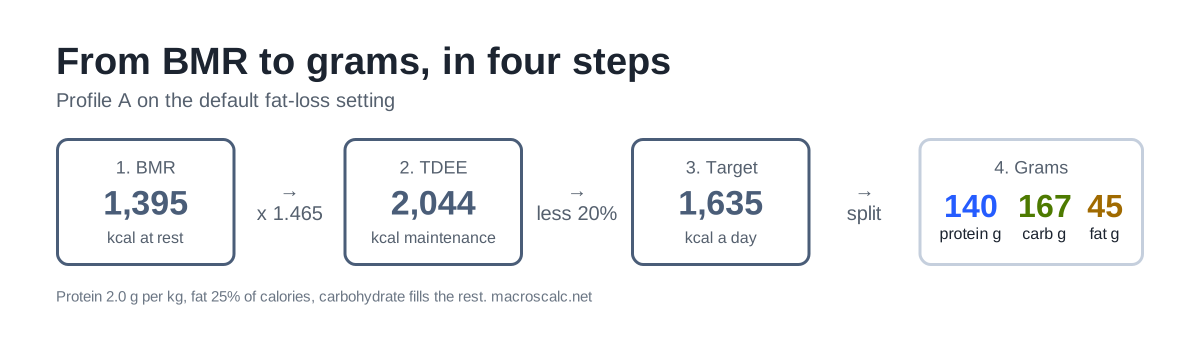
Changing the goal changes only step 3 and the split that follows. The macros for weight loss guide explains the deficit sizes, and the how to calculate macros guide walks the full chain by hand. The macro calculator prints each of these four lines so you can check them.
Worked Examples: Two Profiles, Several Activity Levels
How does BMR differ for two bodies? Both profiles use the Mifflin-St Jeor equation, since neither enters a body fat figure, and the calculator’s six activity factors. Calories are carried unrounded and rounded to the nearest kcal only at the end.
The table puts both profiles on the same six levels. The BMR row is the same at every level, so every difference below it comes from the factor alone.
Row | Factor | Profile A: woman, 35 y, 165 cm, 70 kg | Profile B: man, 28 y, 180 cm, 82 kg |
|---|---|---|---|
BMR | none | 1,395 | 1,810 |
Sedentary TDEE | 1.2 | 1,674 | 2,172 |
Light TDEE | 1.375 | 1,918 | 2,489 |
Moderate TDEE | 1.465 | 2,044 | 2,652 |
Active TDEE | 1.55 | 2,163 | 2,806 |
Very Active TDEE | 1.725 | 2,407 | 3,122 |
Extra Active TDEE | 1.9 | 2,651 | 3,439 |
Example A: What Is BMR at 1,395 With Six Activity Levels?
Profile A starts with 10 × 70 = 700, plus 6.25 × 165 = 1,031.25, minus 5 × 35 = 175, minus 161. That gives a BMR of 1,395.25 kcal. At Moderate activity, 1,395.25 × 1.465 = 2,044 kcal.
The spread from Sedentary to Extra Active is 977 kcal a day for the same body. Moving up one level adds between 119 and 244 kcal for her, depending on the step.
Example B: What Is BMR at 1,810, and What Does Moderate Add?
Profile B starts with 10 × 82 = 820, plus 6.25 × 180 = 1,125, minus 5 × 28 = 140, plus 5. That gives a BMR of exactly 1,810 kcal. At Moderate activity, 1,810 × 1.465 = 2,651.65, which rounds to 2,652 kcal.
His BMR is 415 kcal above Profile A’s, and that gap grows with every factor, to 788 kcal at Extra Active. Larger bodies carry the multiplier further.
Example C: What Activity Alone Does
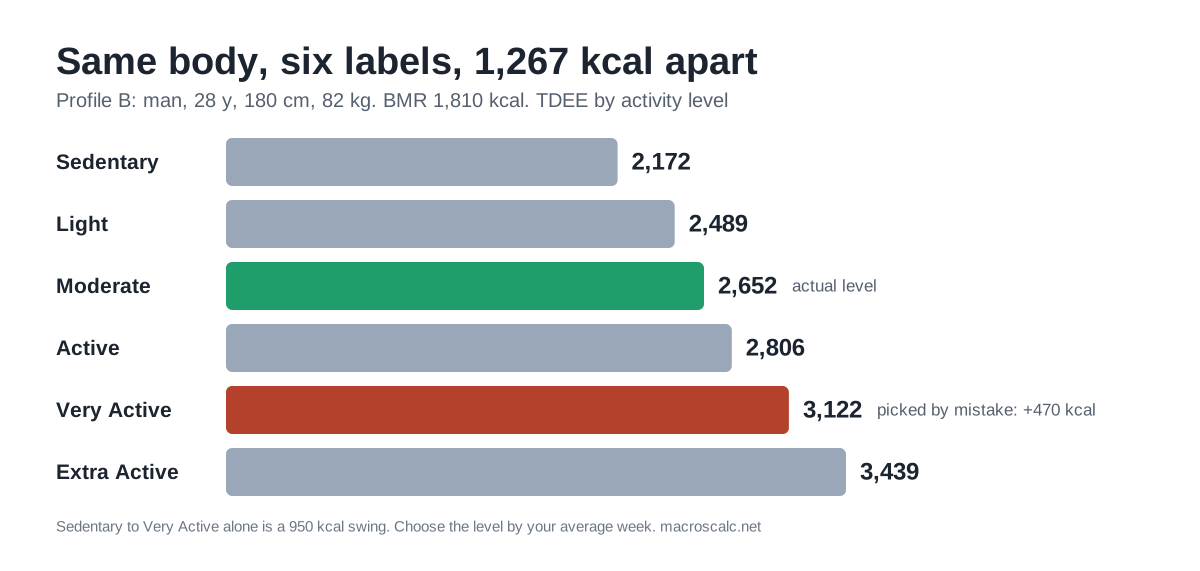
Keep Profile B fixed and change only the label. Sedentary gives 2,172 kcal and Very Active gives 3,122 kcal, a swing of 950 kcal a day, or 6,650 kcal a week, with no change in his body.
The practical risk is picking the wrong row. If he is really Moderate but selects Very Active, his TDEE is overstated by 470 kcal a day, nearly the size of a 500 kcal deficit. For Profile A the same one-step slip from Moderate to Very Active costs 363 kcal.
How to Interpret Your BMR and TDEE Numbers
What does it mean in practice? BMR alone is not a daily target, because it counts no movement at all. Eating at BMR puts Profile A 649 kcal below her Moderate TDEE of 2,044, and Profile B 842 kcal below his 2,652. Both are about 32% under maintenance. For Profile B that is more than the 500 to 750 kcal a day deficit the 2013 AHA/ACC/TOS obesity guideline recommends as a starting deficit.
What is the margin of error? Treat both numbers as estimates with a margin. In a systematic review of equations, Frankenfield and colleagues found Mifflin-St Jeor predicted resting rate within 10% of measured in more nonobese and obese adults than any other equation tested. It also had the narrowest error range. They also reported noteworthy errors in individuals. A 10% band around Profile A’s BMR is 1,256 to 1,535 kcal, and around Profile B’s it is 1,629 to 1,991 kcal.
The activity factor adds its own error on top of that band. Use the output as a starting estimate, run it for two to three weeks and compare your average weight trend with the plan.
What a 100 kcal Gap Means
A 100 kcal difference per day is 700 kcal a week, which the common 3,500 kcal per pound rule of thumb turns into about 0.2 lb. That rule overstates the effect over longer periods, and in any case the gap sits well inside the error of the estimate. A single wrong activity step moves TDEE by 119 to 363 kcal in the examples above.
So do not chase 100 kcal differences between two calculators. Differences that size usually come from the equation each one uses. What matters is a consistent number you adjust from your own results.
Calculate BMR and TDEE in Code
The whole chain is two small functions. This snippet uses the same equation and factors as the calculator. It reproduces the worked examples above (run by script: Profile A prints 1395 and 2044, Profile B prints 1810 and 2652).
FACTORS = {"sedentary": 1.2, "light": 1.375, "moderate": 1.465,
           "active": 1.55, "very_active": 1.725, "extra_active": 1.9}

def bmr_mifflin(sex, age, height_cm, weight_kg):
    base = 10 * weight_kg + 6.25 * height_cm - 5 * age
    return base + (5 if sex == "male" else -161)

def tdee(bmr, level):
    return bmr * FACTORS[level]

a = bmr_mifflin("female", 35, 165, 70)
print(round(a), round(tdee(a, "moderate")))   # 1395 2044
Safety and Limits: Who These Numbers Fit
What does this mean for safety? BMR and TDEE are population-equation estimates for healthy adults. They are not measurements, and they are not medical advice. The calculator is built for adults and stops when inputs fall outside its range. It applies calorie floors of 1,200 kcal for women and 1,500 kcal for men when it builds a target from TDEE.
These estimates do not fit people under 18, pregnancy or breastfeeding, or anyone managing a medical condition or eating disorder. Calorie levels below 800 kcal a day belong under medical supervision, as the 2013 AHA/ACC/TOS guideline notes for very low calorie diets. If your situation is any of these, use a clinician’s figure instead of a formula.
Common BMR and TDEE Mistakes
Most bad targets trace back to one of the errors below. Each row names the size of the damage using the two profiles above.
Mistake | What goes wrong | Fix |
|---|---|---|
Eating at BMR | A deficit of about 32% below maintenance at Moderate activity: 649 kcal for Profile A, 842 for Profile B | Build the target from TDEE minus a chosen deficit |
Picking the level by your best week | One step too high adds 119 to 363 kcal a day to TDEE | Choose by your average week, and take the lower level if torn |
Counting exercise twice | Selecting Active, then adding tracked workout calories on top, double counts the same sessions | Use the factor or add logged exercise to a Sedentary base, never both |
Entering pounds as kilograms | Profile A typing 154 instead of 70 gets a BMR of 2,235, which is 840 kcal too high | Check the unit switch before reading the result |
Comparing BMR across sites | The revised Harris-Benedict equation reads 59 kcal above Mifflin-St Jeor for Profile A and 82 kcal above for Profile B | Compare only results built on the same equation |
Using a tracker’s daily total as TDEE | It is a separate estimate from a different method, so the two do not reconcile | Pick one source and adjust it by your weight trend |
Never updating the inputs | Five kilograms of weight change moves BMR by about 50 kcal | Re-enter your weight after any change of that size |
The first two rows account for most of the damage in practice, because they move the calorie target by hundreds of kcal and not tens. The rest are quieter and tend to show up only when progress stalls.
BMR, RMR, TDEE and Maintenance Compared
What is BMR next to RMR, TDEE and maintenance? The four terms below are often used as synonyms, and they are not. The table fixes what each one includes and what you would use it for.
What is BMR: measure | What it includes | How you get it | Use it for |
|---|---|---|---|
BMR | Resting needs only, measured fasted, awake and still | Strict lab measurement, or a predictive equation | The base term in every energy calculation |
RMR | Resting needs under looser conditions, usually slightly higher | Indirect calorimetry, or the same equations | Interchangeable with BMR for macro targets |
TDEE | BMR plus exercise, daily movement and digestion | BMR times an activity factor | Estimating maintenance calories |
Maintenance calories | The TDEE value treated as an intake level | Taken from TDEE | The reference point a deficit or surplus is set from |
In the calculator the chain runs one way: BMR, then TDEE, then a calorie target, then grams. Only the last two depend on your goal, so a clean BMR and TDEE make every later step easier to check.
FAQs
Short answers to what is BMR and the other questions people ask most about these two numbers.
Conclusion
What is BMR in one line? It is the energy your body spends at rest, and TDEE is that figure scaled by how active you are. Together they give the maintenance estimate that every calorie target and macro split is built from.
Use both as starting estimates, not facts about your body. Enter your stats in the macro calculator to see your own BMR, TDEE and grams with every step printed, then adjust after two to three weeks of results.